Skip to main content


 01274 442076



When Does a PCN Need Specialist pharmacist Support Rather Than More General Capacity?
|
Getting your Trinity Audio player ready...
|
- What does specialist pharmacist support mean?
- Is your backlog a capacity problem or an expertise problem?
- What are the signs a PCN needs specialist pharmacist support?
- When is more general pharmacist capacity the better answer?
- Can the existing team develop the expertise instead?
A PCN needs specialist pharmacist support when a defined clinical problem exceeds its team’s expertise. It needs more general capacity when skilled clinicians cannot keep pace. The distinction changes what you commission, so diagnose the gap first.
Key takeaways
- Diagnose before you recruit: a prescribing queue can reflect capacity, workflow or expertise.
- Qualification is not competence: prescribing status confirms a qualification, not clinical competence for every group.
- Specialist support can be targeted: case advice, joint reviews or a clinic may suffice.
- Measure locally: agree what should improve, then review it.
How to tell the difference in four steps
- Review a representative sample of outstanding and escalated cases.
- Record what prevented completion: time, information, competence or pathway clarity.
- Check whether that competence or clinical supervision already exists in the PCN.
- Group by cause.
What does specialist pharmacist support mean?
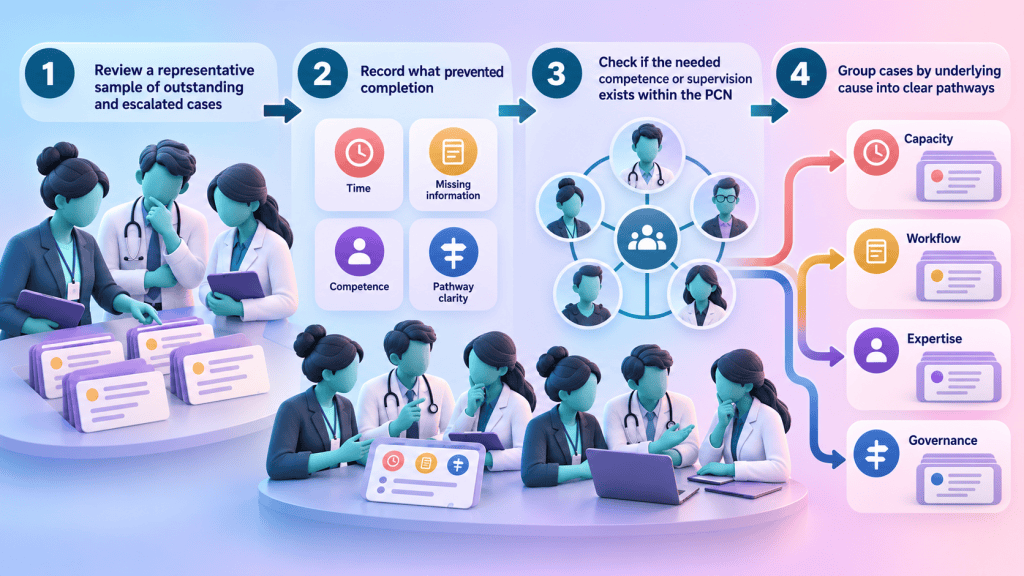
Specialist pharmacist support means expertise matched to a defined clinical need, not more appointments. It may be advice on a complex case, a joint review, or a clinic. “Specialist” describes the expertise required, not seniority.
The GPhC’s in practice guidance for pharmacist prescribers expects prescribers to work within their pharmacist scope of practice and to refer when not competent to prescribe. A qualification does not guarantee clinical competence for every group.
Is your backlog a capacity problem or an expertise problem?
Ask one question: with protected time and clear information, could the team safely complete this work? If yes, the constraint is likely capacity or workflow. If cases stall for want of competence, the gap may be expertise. Clinical decision making beyond the team’s competence is unlikely to be resolved by extra sessions. Where a shared care agreement has no named owner, the gap is governance.
| What you are seeing | Likely explanation | Response to investigate |
|---|---|---|
| Established tasks accumulate but are completed safely | Capacity | More sessions and protected time |
| Pharmacists lose clinical time chasing information | Workflow or skill mix | Redesign task allocation |
| The same clinical questions keep returning to GPs | Expertise or pathway gap | Targeted specialist advice or a clearer route |
| Complex cases sit unresolved alongside routine work | Capacity and expertise | Capacity plus specialist access |
| Shared care agreement responsibilities unclear | Governance gap | Agree prescribing, monitoring and escalation |
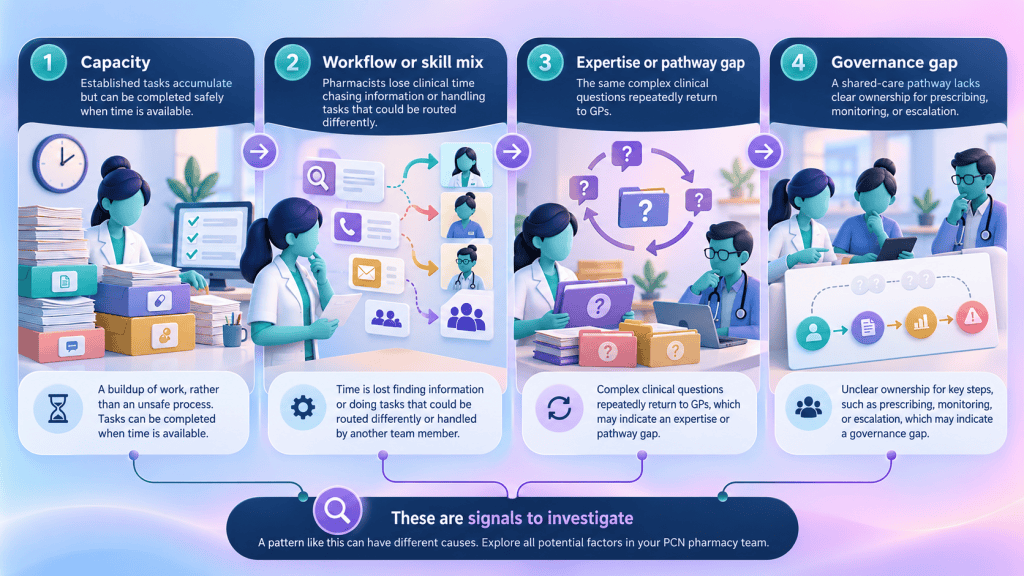
What are the signs a PCN needs specialist pharmacist support?
Not sure whether your PCN needs more capacity or specialist pharmacy input?
Discuss your pharmacy workforce gapFour patterns point to expertise rather than sessions:
- A defined patient group repeatedly needs advice beyond the team’s scope.
- Medication decisions in multimorbidity involve competing risks routine pathways do not resolve.
- A recurring prescribing or monitoring problem persists despite corrective work – see our medication-related hospital admissions toolkit.
- Responsibility for monitoring is unclear when a shared care agreement applies.

Patient complexity is why volume alone is a poor guide. NICE’s multimorbidity guidance highlights treatment burden and competing priorities; a high medicine count alone does not establish that specialist input is required. Where a shared care agreement applies, clarify who prescribes, monitors and acts on results.
When is more general pharmacist capacity the better answer?
Additional capacity is the right response when the work sits within the team’s competence, clinical supervision is adequate and the constraint is time. Pathways and escalation routes function, work accumulates broadly, and pharmacists lose clinical time to administration. A medication review backlog does not, by itself, establish a need for specialist input. Our guide to PCN multidisciplinary team design covers allocating work across the team.
Can the existing team develop the expertise instead?

Sometimes. Structured training, mentoring and supervised practice can close a gap, and the CPPE pathway builds assessed learning. Development is rarely immediate, so where expertise is needed now, our training and development programmes complement specialist input.
Specialist advice sits alongside clinical supervision; it does not replace it. NHS England’s supervision guidance states that specialist input supplements, but cannot replace, the oversight a PCN provides.
Expert insight from Adeem Azhar, qualified Clinical Pharmacist and CEO
The question we ask practices and PCNs is whether the work is waiting for time or waiting for the right expertise. Teams that can answer it pragmatically usually agree the right support quickly suited to their needs.
Adeem Azhar, MPharm, IPres
Co-Founder and Chief Executive Officer – Core Prescribing Solutions
Qualified Clinical Pharmacist

FAQs
Match your pharmacy support to the gap your PCN actually has
Core Prescribing Solutions can help GP practices and PCNs define whether pressure is coming from general capacity, workflow, supervision or a more specific expertise gap. We can then help shape a proportionate pharmacy support model around agreed workstreams, competence, governance and local priorities.
Discuss your PCN pharmacy requirements