Core Prescribing Solutions
Blog
Home » Core Prescribing Solutions Blog
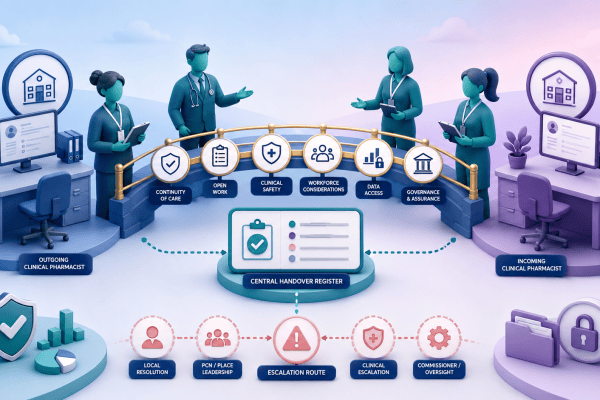
Changing Clinical Pharmacy Providers: TUPE, DPIA and a Safe Transition Checklist for PCNs
- 31st August 2026
- Adeem Azhar, MPharm, IPres
What should a PCN pharmacy service handover checklist include? Does TUPE apply when changing clinical pharmacy providers? Looking for support with a clinical pharmacy provider transition? When is a DPIA required during a clinical pharmacy provider transition? What does a...
Read More...

Atrial Fibrillation PCN Management: A Practical Stroke-Prevention Pathway
- 28th August 2026
- Adeem Azhar, MPharm, IPres
How can an atrial fibrillation PCN improve stroke prevention? Looking for support with an atrial fibrillation PCN pathway? What should atrial fibrillation management in primary care include? How do AF006 and AF008 support atrial fibrillation QOF work? What roles should...
Read More...

Population Health Management in PCNs: Turning Risk Data into Proactive Care
- 21st August 2026
- Adeem Azhar, MPharm, IPres
Population health management helps PCNs turn local data, clinical judgement and multidisciplinary capacity into proactive care. It gives leaders a practical way to define a priority, identify people who may benefit and coordinate a response before needs escalate. PCN pharmacy...
Read More...

A PCN Pharmacist’s Toolkit for Safer Chronic Pain Management
- 17th August 2026
- Adeem Azhar, MPharm, IPres
What should PCN pharmacist pain management include? Who should be prioritised for a chronic pain medication review? What does care beyond opioids look like? How can PCNs support opioid reduction without rigid targets? How should a PCN measure improvement? PCN pharmacist pain management works best as...
Read More...

Antibiotic Prescribing Audits in PCNs: A Practical Guide
- 15th August 2026
- Adeem Azhar, MPharm, IPres
How can a PCN run an antibiotic prescribing audit? What should a PCN antibiotic prescribing audit measure? Where can PCNs find prescribing data? How should PCNs use audit and feedback? When should a PCN re-audit antibiotic prescribing? The UKHSA ESPAUR report recorded 20,484 antibiotic-resistant bacteraemia episodes...
Read More...

Respiratory Disease Management Beyond Asthma and COPD
- 11th August 2026
- Adeem Azhar, MPharm, IPres
PCN respiratory care should reach beyond asthma and COPD registers. It helps teams find gaps in medicines, prevention and follow-up while retaining specialist input. OHID’s respiratory disease profile recorded 873,461 respiratory emergency admissions in the financial year ending 2025, showing why local scope...
Read More...

Vaccination Programme Planning for Primary Care Networks
- 7th August 2026
- Adeem Azhar, MPharm, IPres
PCN vaccination planning programme Building vaccination workforce capacity Call and recall best practice Improving vaccine uptake Effective vaccination programme planning is essential to delivering safe, efficient and high-performing seasonal vaccination services. For Primary Care Networks (PCNs), successful vaccination delivery in...
Read More...

Understanding the NHS Workforce Plan: What It Means for Primary Care Networks
- 3rd August 2026
- Adeem Azhar, MPharm, IPres
Five Practical Steps for PCN Workforce Planning What is the NHS Long Term Workforce Plan? What does the NHS workforce plan mean for PCNs? How does ARRS fit into the NHS workforce plan? How can PCNs strengthen workforce planning? The...
Read More...

Proactive Care Models in PCNs: Identifying High-Risk Patients Before Crisis
- 24th July 2026
- Adeem Azhar, MPharm, IPres
What is a proactive care model in a PCN? How do you build a proactive care model? Which patients are most likely to benefit from proactive care? How can PCNs identify high-risk patients? Why is risk stratification alone not enough?...
Read More...

Population Health Analytics: Using NHS Digital Data for PCN Planning
- 20th July 2026
- Adeem Azhar, MPharm, IPres
What NHS data sources should PCNs use for service planning? How to turn population health insights into action Why is prescribing analysis critical for medicines optimisation? Understanding the limitations of national datasets Primary Care Networks have access to more health...
Read More...
 Skip to main content


 01274 442076


