Skip to main content


 01274 442076



Respiratory Disease Management Beyond Asthma and COPD
|
Getting your Trinity Audio player ready...
|
PCN respiratory care should reach beyond asthma and COPD registers. It helps teams find gaps in medicines, prevention and follow-up while retaining specialist input. OHID’s respiratory disease profile recorded 873,461 respiratory emergency admissions in the financial year ending 2025, showing why local scope matters.
Key takeaways
- A wider pathway can connect prevention, medicines safety and post-discharge follow-up for defined local cohorts.
- A pharmacist-led respiratory service adds capacity when its scope, supervision and escalation routes are explicit.
- Bronchiectasis and interstitial lung disease need meaningful medicines support, but their specialist boundaries must remain clear.

Why does PCN respiratory care need to go beyond asthma and COPD?
Respiratory disease management in primary care cannot stop at the asthma and COPD registers. The OHID respiratory disease profile covers acute and chronic conditions and shows marked regional variation.
That does not mean creating a specialist clinic inside general practice. It means using clinical data and Clinical Pharmacy capacity to spot gaps in treatment, prevention and follow-up. Detailed inhaler support belongs in the Inhaler Technique Primary Care guide.
How can PCNs build a safe respiratory pathway?
Start with four practical steps:
- Agree the scope. Define the cohort, review criteria, supervision and escalation routes before case-finding begins.
- Use local data. Look for recent admissions, repeated treatment courses, missed vaccines, persistent symptoms and changing inhaler use.
- Review within competence. Suitably trained prescribing pharmacists may assess and diagnose within their individual competence and local governance.
- Escalate and learn. Refer for specialist assessment when needed, record the action and re-audit the pathway.

The PCN DES 2026/27 implementation plan sets delivery context. NHS England’s Network Contract DES specificationassigns ARRS Clinical Pharmacists responsibilities for clinical medication reviews, person-centred medicines optimisation and pharmacy-team integration. The ARRS Clinical Pharmacy delivery model supports workforce planning.
What does support look like beyond asthma and COPD?
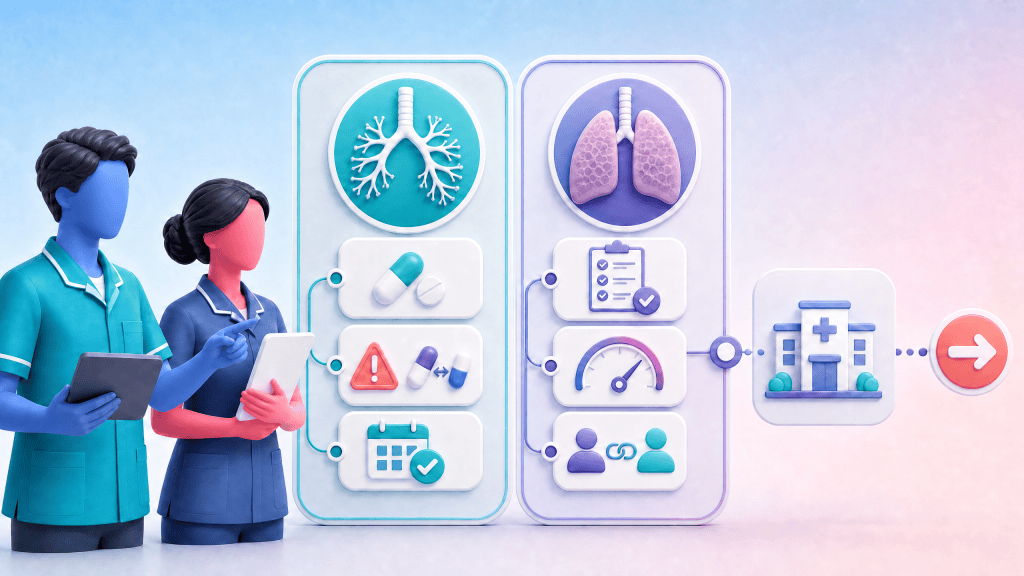
Respiratory medicines optimisation can include discharge reconciliation, adherence and adverse-effect checks, vaccine review, antimicrobial stewardship, and rehabilitation or smoking-cessation referral.
For people with bronchiectasis, the pharmacy team can identify repeat antibiotic exposure, interactions, adherence and prevention gaps. NICE NG117 covers antimicrobial prescribing for acute exacerbations, including reassessment, referral and specialist advice. Recurrent exacerbations or complex antibiotic decisions should follow the agreed respiratory pathway.
For suspected or established interstitial lung disease, pharmacy teams can reconcile medicines, check monitoring and coordinate shared care. NICE CG163 requires interstitial-lung-disease multidisciplinary-team consensus for idiopathic pulmonary fibrosis diagnosis. The role is to support safe continuity of care, not to replace specialist assessment.
What should a PCN measure?
A respiratory structured medication review should record the intervention and its outcome. Useful measures include reviews completed, discrepancies corrected after discharge, prevention gaps identified, repeat antibiotics reviewed, appropriate referrals and patient understanding.

PCN respiratory care should also show whether outreach reaches high-risk respiratory patients. This informs improvement without attributing admission changes to one service.
Expert insight from Adeem Azhar, qualified Clinical Pharmacist and CEO
Sustainable respiratory work starts with defined scope, reliable supervision and clear escalation. That adds capacity without blurring specialist responsibilities.
Adeem Azhar, MPharm, IPres
Co-Founder and Chief Executive Officer – Core Prescribing Solutions
Qualified Clinical Pharmacist
How should a PCN govern the service?
Respiratory medicines optimisation needs clear roles, senior Clinical Pharmacy supervision, GP support, local formularies and documented escalation. The Network Contract DES specification requires regular senior-pharmacist supervision and access to an assigned GP clinical supervisor.
Prevention provides a timely example. The UKHSA RSV vaccination guidance confirms that, from 1 September 2026, previously unimmunised people aged 65–74 years with defined chronic respiratory disease or immunosuppression become eligible. Local delivery should follow current national guidance and commissioning arrangements.

FAQs
Looking for support with your PCN pharmacy workforce?
Core Prescribing Solutions provides Clinical Pharmacist support for targeted long-term-condition and respiratory work. We help PCNs build capacity around defined scope, supervision, local pathways and measurable delivery.
Contact us today