Skip to main content


 01274 442076



Understanding Clinical Audits in Primary Care
|
Getting your Trinity Audio player ready...
|
Updated: August 2026
- What is a Clinical Audit?
- Clinical Audit in the NHS: How it Works in Primary Care
- Understanding the Clinical Audit Cycle
- NICE Guidelines for Clinical Audit: How NICE guidance Supports Audits
- Examples of Clinical Audits in Practice
- How to Conduct an Effective Clinical Audit
- Clinical audits and medicines optimisation
- The Role of Clinical Audits in Governance & Quality Improvement
- How We Support Clinical Audit in Primary Care
A clinical audit is a structured process used to check whether healthcare is being delivered in line with agreed standards. In primary care, clinical audits help GP practices, PCNs and pharmacy teams review everyday care, identify gaps and make practical improvements to patient safety, prescribing quality and service delivery.
Key Takeaways:
- Clinical audits help primary care teams check whether agreed standards are being met.
- A strong NHS clinical audit process supports quality improvement, safer care and better accountability.
- NICE guidance and quality standards can help define audit criteria, measures and improvement priorities.
What is a Clinical Audit?
A simple clinical audit definition is this: a clinical audit is a quality improvement process that measures current care against agreed standards, identifies where practice could improve, implements change and then re-audits to check whether improvement has been sustained.
For anyone asking what is a clinical audit, the key point is that it reviews existing care rather than testing a new treatment. This is what gives clinical audit meaning in practice. It helps teams ask, “Are we doing what we should be doing, and how can we improve?”
A clinical audit may also be described as a healthcare audit or medical audit, although clinical audit is the more common NHS term.
Clinical Audit in the NHS: How it Works in Primary Care
AThe phrase clinical audit NHS usually refers to audit activity carried out across NHS services to review care against standards and improve quality. In primary care, this may involve checking prescribing, medication reviews, patient records, monitoring processes, long-term condition care or safety procedures.
A good audit should be:
- Relevant to patient care
- Based on clear standards
- Supported by accurate data
- Linked to a realistic action plan
- Repeated through re-audit
- Used to improve care, not just collect information
For GP practices and PCNs, the value comes when audit findings lead to practical change. A spreadsheet of results is not enough. The audit should support safer processes, clearer accountability and better outcomes for patients.
Understanding the Clinical Audit Cycle
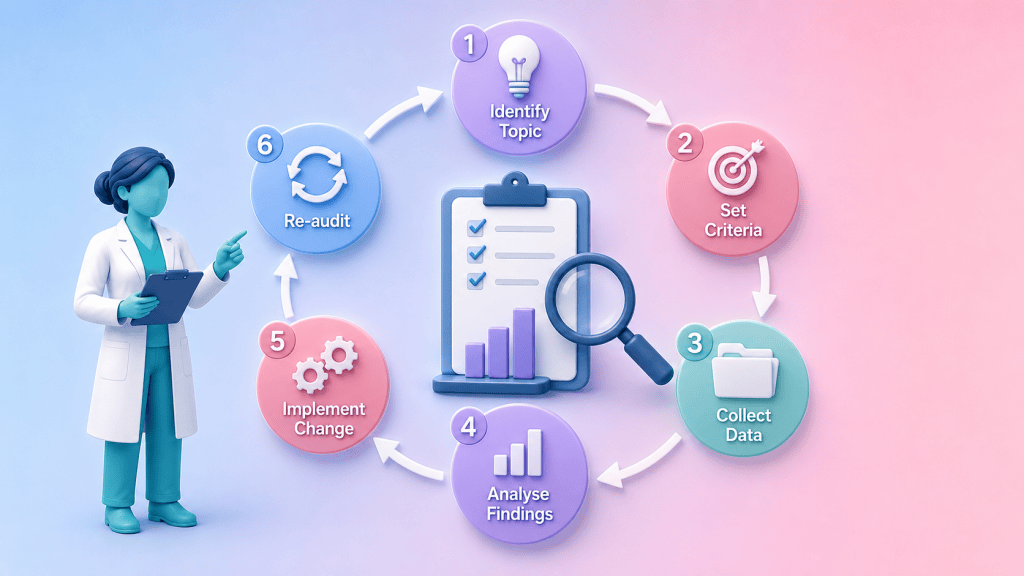
The clinical audit cycle is the step-by-step process used to review care, make improvements and check whether those improvements have worked. It is sometimes referred to as the audit cycle NHS or clinical audit cycle NHS.
The typical clinical audit cycle includes:
- Identify the audit topic
Choose an area where improvement may be needed, such as prescribing safety, medication reviews, monitoring or record keeping.
- Set criteria and standards
Define what good care should look like. This may be based on NICE guidance, local policy, national standards or agreed clinical pathways.
- Collect data
Review current practice using accurate and relevant information from clinical systems, records or service data.
- Analyse findings
Compare current care with the agreed standards and identify gaps, variation or risks.
- Implement change
Put practical improvements in place, such as updated processes, staff training, prescribing changes or clearer documentation.
- Re-audit
Repeat the audit to check whether the changes have improved care and whether the improvement has been sustained.
This is the part often missed. Without re-audit, it is difficult to know whether the work has led to real improvement.
Related Read: What is a structured medication review
NICE Guidelines for Clinical Audit: How NICE guidance Supports Audits
NICE clinical audit activity usually means using NICE guidance, quality standards or indicators to support audit criteria and measurement. NICE does not run every local clinical audit, but its guidance can help teams define what good care should look like.
NICE quality standards are useful because they highlight priority areas for improvement and include measures that can help organisations assess progress.
In primary care, NICE guidance may support audits around:
- Medicines optimisation
- Long-term condition management
- Prescribing safety
- Monitoring requirements
- Patient reviews
- Referral pathways
- Preventive care
- Clinical documentation
The main benefit is consistency. When audits are linked to recognised standards, teams can make clearer decisions about where improvement is needed.
Examples of Clinical Audits in Practice
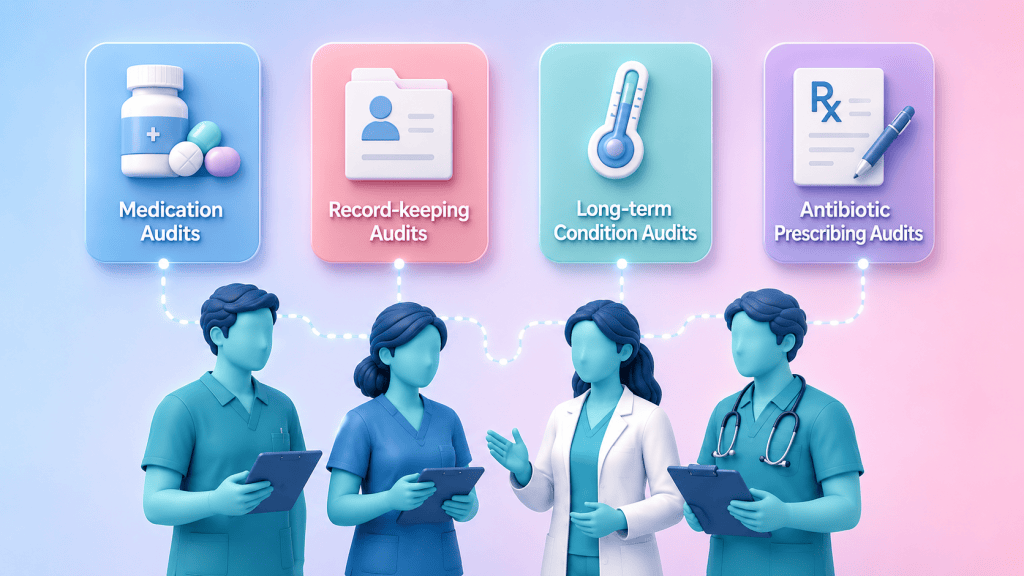
TThere are many examples of clinical audit in primary care. The best audit topic is usually one that is clinically important, measurable and likely to lead to practical improvement.
Common clinical audits examples include:
- Medication audits: Reviewing prescribing safety, monitoring and medicine use
- Structured Medication Review audits: Checking whether eligible patients are being reviewed appropriately
- High-risk drug monitoring audits: Reviewing blood tests, follow-up and safety checks
- Antibiotic prescribing audits: Checking prescribing patterns against local or national guidance
- Long-term condition audits: Reviewing care for diabetes, hypertension, asthma or cardiovascular disease
- Record-keeping audits: Checking accuracy, coding and completeness of clinical records
- Referral audits: Reviewing appropriateness, documentation and follow-up
- Patient recall audits: Checking whether patients are being invited for reviews or monitoring on time
These audits in healthcare help teams move from assumption to evidence. They show where care is working well and where processes need to be improved.
How to Conduct an Effective Clinical Audit
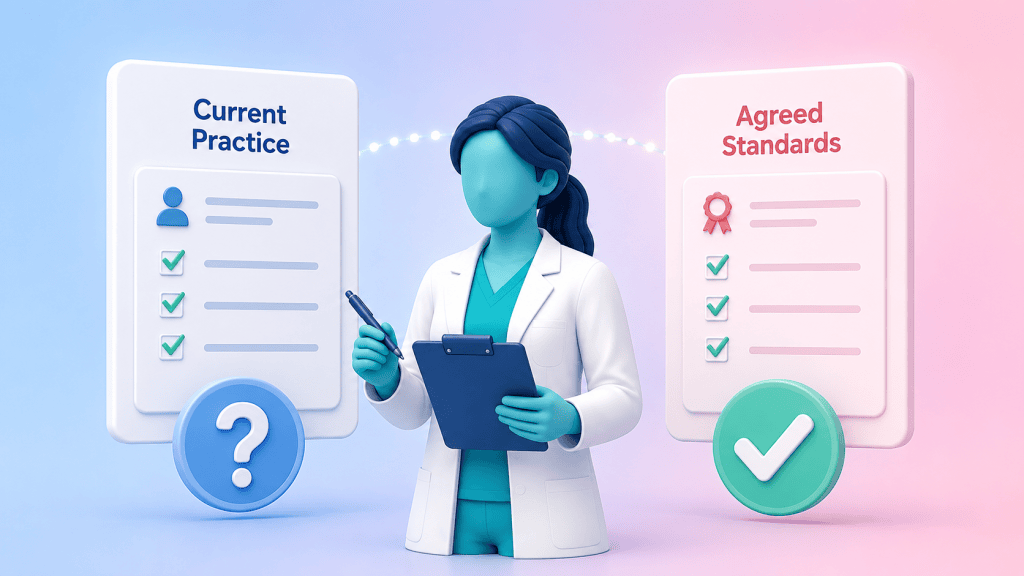
Knowing how to do a clinical audit properly is important because weak audits can waste time and produce little change. The strongest audits are focused, measurable and linked to action.
A practical process includes:
- Choose a clear topic
Select an issue that matters to patient safety, care quality or service delivery.
- Define the standard
Use NICE guidance, NHS standards, local policy or agreed clinical criteria.
- Set measurable criteria
Be clear about what will be measured and what level of performance is expected.
- Collect accurate data
Use reliable data from clinical systems, records, prescribing searches or patient review activity.
- Review the results
Identify gaps, variation and areas where practice does not meet the agreed standard.
- Create an action plan
Agree what will change, who is responsible and when it will happen.
- Re-audit
Check whether the change has improved practice and whether further action is needed.
This keeps the clinical audit process practical and focused on improvement rather than paperwork.
Need support turning clinical audit findings into practical improvement?
Discuss clinical audit supportClinical audits and medicines optimisation
Clinical audits are especially useful in medicines optimisation because prescribing activity is measurable, repeatable and closely linked to patient safety.
In primary care, audits can help identify:
- Patients missing medication reviews
- High-risk medicines without recent monitoring
- Repeat prescribing issues
- Variation in prescribing between practices
- Patients who may benefit from Structured Medication Reviews
- Gaps in discharge medicines reconciliation
- Opportunities to improve safety, adherence and review processes
This is where clinical pharmacists and pharmacy technicians can add significant value. Pharmacists can support clinical interpretation and medicines optimisation, while pharmacy technicians can help with data collection, recalls, documentation and workflow management within their scope.
The Role of Clinical Audits in Governance & Quality Improvement
Clinical audits are part of clinical governance because they help organisations assess, monitor and improve the quality of care. They also support accountability by demonstrating whether services meet agreed standards.
In primary care, audits can help with:
- Patient safety
- Prescribing quality
- Risk management
- Service improvement
- Workforce consistency
- PCN-wide standardisation
- Evidence for quality improvement work
A good audit should not be treated as a one-off exercise. It should feed into wider quality improvement, team learning and service planning.

Core Prescribing Solutions Insight: What we see in Primary Care
In primary care, clinical audits are most valuable when they are tied to real operational pressure points, such as repeat prescribing, medication reviews, high-risk drug monitoring and long-term condition management. The audit itself is only the starting point. The real improvement comes from clear ownership, practical action and re-audit to confirm that safer processes are actually being followed.
Expert comment from our CEO and qualified clinical pharmacist:
Expert insight from Adeem Azhar, qualified Clinical Pharmacist and CEO
“Clinical audit is most effective when it moves beyond data collection and leads to practical change. In primary care, audits can highlight risks in prescribing, monitoring and medication review processes, but the value comes from acting on those findings, assigning responsibility and re-auditing to make sure improvement has been sustained.”
Adeem Azhar, MPharm, IPres
Co-Founder and Chief Executive Officer – Core Prescribing Solutions
Qualified Clinical Pharmacist
How We Support Clinical Audit in Primary Care

Clinical audit only adds value when the findings lead to safer processes, clearer ownership and measurable improvement. Our clinical pharmacy team helps GP practices and PCNs review medicines-related activity, identify gaps and turn audit results into practical action.
This can include:
- Reviewing audit criteria for medicines optimisation, prescribing safety and monitoring
- Identifying gaps in repeat prescribing, medication reviews and high-risk drug monitoring
- Supporting data collection, recalls and workflow checks through pharmacy technician input
- Turning audit findings into practical actions with clear ownership
- Re-auditing to check whether improvements have been sustained
- Actioning MHRA alerts where appropriate
This helps clinical audit move beyond data collection and become part of safer, more consistent primary care delivery.
Frequently Asked Questions
Turn clinical audit into measurable improvement across your PCN
Core Prescribing Solutions can support practices and PCNs with medicines-related clinical audits, data review, workflow checks and improvement planning. Our Clinical Pharmacists and Pharmacy Technicians can help identify gaps in prescribing, monitoring and medication-review processes, implement practical actions and re-audit to confirm that improvements are sustained.
Discuss your clinical audit priorities