Skip to main content


 01274 442076



Atrial Fibrillation PCN Management: A Practical Stroke-Prevention Pathway
|
Getting your Trinity Audio player ready...
|
- How can an atrial fibrillation PCN improve stroke prevention?
- Looking for support with an atrial fibrillation PCN pathway?
- What should atrial fibrillation management in primary care include?
- How do AF006 and AF008 support atrial fibrillation QOF work?
- What roles should the clinical pharmacy team have in AF management?
An atrial fibrillation PCN pathway aligns case-finding, risk review and anticoagulation for atrial fibrillation stroke prevention. It must complement clinical judgement, shared decision making and local specialist pathways, in line with NICE guidance.
For readers asking what is atrial fibrillation, it is an irregular heart rhythm. This article focuses on the PCN workflow, not individual treatment decisions.
Key takeaways
- Shared case-finding: An atrial fibrillation PCN can use one search and recall method to identify patients needing follow-up.
- Clinical guardrails: Stroke and bleeding risk, treatment suitability and patient preference need a NICE-aligned review process.
- Defined roles: Clinical pharmacists lead clinical review; pharmacy technicians can support data quality, recalls and protocol-led preparation within competence.
- Outcome focus: A simple dashboard reveals variation, outstanding actions and safety exceptions.
A useful pathway is Detect, Protect, Perfect and Review:

- Detect patients with possible or under-managed AF.
- Protect eligible patients through documented risk review and treatment decisions.
- Perfect care with safe medicines processes and timely escalation.
- Review outcomes and variation across the network.
How can an atrial fibrillation PCN improve stroke prevention?
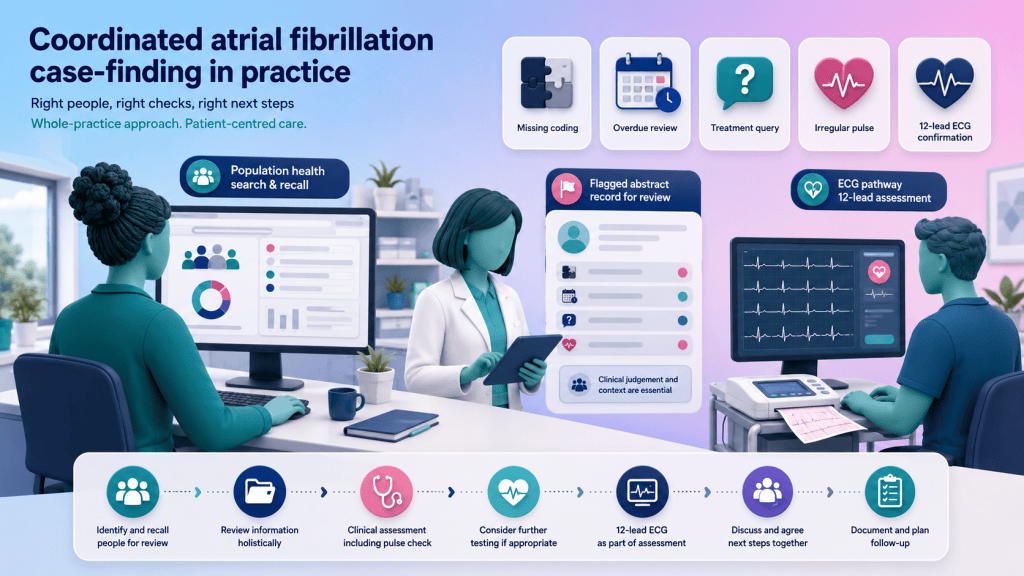
A well-run atrial fibrillation management in primary care pathway gives an atrial fibrillation PCN one shared search, recall process and escalation route. Use it to flag missing coding, overdue reviews and treatment queries. NICE recommends a 12-lead ECG to confirm AF when an irregular pulse is detected.
Protect uses consistent clinical information: diagnosis, indication, stroke-risk and bleeding-risk assessment, relevant renal function, medicines and patient preferences. It should not generate automatic prescribing decisions. Instead, direct complex, uncertain or out-of-scope cases to the appropriate prescriber, clinician or specialist service.
Need support building an effective AF pathway across your PCN?
Discuss your AF pathwayWhat should atrial fibrillation management in primary care include?
A practical atrial fibrillation management in primary care pathway needs a clinical lead and weekly worklist. Triage incomplete risk assessments, treatment queries, monitoring needs and outstanding contacts. Clinical Pharmacist Services can lead complex assessment and prescribing within their scope. Pharmacy technicians can run searches, prepare records and coordinate recalls under clear supervision.
The Perfect stage should include an anticoagulation optimisation in primary care check. Under local protocols, review medication, dose, renal function and safety-netting. This is targeted medicines optimisation, not a generic medication-review campaign. Escalate patients who need a comprehensive structured medication review.
Expert insight from Adeem Azhar, qualified Clinical Pharmacist and CEO
A strong AF pathway does not rely on one clinician’s memory. It makes the right work visible and helps the PCN learn from variation.
Adeem Azhar, MPharm, IPres
Co-Founder and Chief Executive Officer – Core Prescribing Solutions
Qualified Clinical Pharmacist
How do AF006 and AF008 support atrial fibrillation QOF work?

AF006 and AF008 are practice-level QOF indicators. The pathway described here is a PCN operating model for coordinating care across practices. NHS England’s 2026/27 GP contract update raised AF006’s upper threshold from 90% to 95%. Its 12 points are unchanged. Strong practice processes matter, but this is not a separate national PCN DES AF service.
The PCN role is to enable consistency. Agree shared search logic, local clinical governance and a route for each practice to resolve exceptions. Track variation across the network. Do not blur accountability for individual clinical decisions.
What roles should the clinical pharmacy team have in AF management?

Clinical pharmacists should undertake clinical assessment and make or support treatment decisions within their competence. They should escalate exceptions. Pharmacy technicians can manage search quality, patient-contact workflows and document retrieval under agreed protocols. The role of clinical pharmacists in PCNs works best when these responsibilities are explicit.
| KPI | Why it matters | Review cadence |
|---|---|---|
| Patients with an outstanding AF review action | Shows operational backlog | Weekly |
| Completion of agreed clinical-review worklist | Shows delivery against the pathway | Fortnightly |
| Unresolved dose, renal or bleeding-risk exceptions | Supports safety governance | Weekly |
| Variation between practices | Identifies where support is needed | Monthly |
FAQs
Strengthen atrial fibrillation management across your PCN
Core Prescribing Solutions can help PCNs design structured clinical pharmacy workflows for AF case-finding, review and escalation across practices. Our approach can be shaped around your local priorities, governance arrangements and workforce capacity.
Discuss AF support for your PCN