Latest News and Info

A clinical pharmacist and GP review medication data on tablets during a consultation.

The Rising Tide of Type 2 Diabetes: How Primary Care Can Improve Outcomes and Workload

Type 2 diabetes is rising across England, with prevalence now at 7.0% of the adult population. For primary care teams, this means growing registers, more complex medication decisions, and increasing pressure on annual review capacity. A diabetes optimisation pharmacist helps practices respond to this challenge by creating a systematic approach to diabetes reviews and implementing NICE guidance safely and consistently. [1]

Key Takeaways

  • Specialist Role: This dedicated expert focuses on improving diabetes care across a PCN, driving improvements in both outcomes and efficiency.
  • Guideline-Driven: Their work aligns with NICE guidelines to reduce variation and ensure evidence-based treatment, particularly around modern therapies that offer cardio-renal protection.
  • Improves Outcomes: This role is key to improving HbA1c in primary care, ensuring cardio renal protection diabetes, and hitting QOF targets.
  • Systematic Approach: They implement structured pathways for medication reviews, therapy escalation, and patient follow-up, creating a more resilient system.

The Scale of the Challenge

Infographic showing the 9 care processes for Type 2 Diabetes, with a statistic showing that only 54.3% of patients complete all nine.
An infographic listing the 9 essential care processes for Type 2 Diabetes management and highlighting the low completion rate of 54.3% in UK primary care.

In England, while diabetes prevalence grows, national data shows that only 54.3% of patients receive all nine NICE-recommended care processes each year. [1] Closing this gap through effective diabetes annual review optimisation is one of the fastest ways to improve outcomes, ensure patient safety, and reduce the need for reactive, urgent care appointments. These gaps in care often lead to missed opportunities to intensify treatment, identify complications early, and reduce long-term cardiovascular risk.

What Does a Diabetes Optimisation Pharmacist Do?

Infographic showing the role of a Diabetes Optimisation Pharmacist, with icons for medication reviews, therapy escalation, annual review completion, safe SGLT2 use, and reduced GP visits.
A visual summary of the key responsibilities of a Diabetes Optimisation Pharmacist in primary care, including medication reviews, therapy escalation, and supporting safe SGLT2 inhibitor use.

A diabetes optimisation pharmacist is a specialist clinical pharmacist who helps primary care networks (PCNs) systematically improve care for patients with type 2 diabetes. By focusing on guideline-directed therapy and proactive case management, they help close gaps in care and improve patient outcomes. Central to this work is diabetes medication optimisation – ensuring every patient is on the right therapy at the right dose. This involves:

  • Running structured medication reviews for complex patients.
  • Identifying patients who need therapy escalation or optimisation.
  • Implementing NICE guideline NG28 guidance, including new recommendations for SGLT2 inhibitors.
  • Optimising blood pressure and lipid control to reduce cardiovascular risk.
  • Ensuring the nine essential care processes are completed and acted upon.
  • Reducing repeat GP appointments through proactive follow-up.

How Does Clinical Pharmacist-Led Optimisation Reduce Workload?

Infographic showing how clinical pharmacists improve HbA1c and reduce GP workload through medication optimisation, HbA1c monitoring, and clinical consultations.
A visual explanation of how clinical pharmacist-led optimisation helps to improve patient HbA1c levels while reducing GP workload in primary care.

The primary goal of clinical pharmacist-led diabetes optimisation is to ensure every patient receives the right care at the right time, according to national standards. A structured clinical pharmacist-led diabetes optimisation pathway allows practices to standardise care and reduce variation across the register. This involves moving beyond simple annual reviews to a more dynamic and responsive model of care. A pharmacist diabetes clinic in primary care provides a dedicated setting for managing more complex patients. For example, a pharmacist diabetes clinic in primary care might prioritise patients with an HbA1c above 58 mmol/mol or those with evidence of kidney disease. By addressing diabetes medication optimisation and monitoring in a single, structured appointment, clinical pharmacists can prevent multiple follow-up GP reviews.

Why is Modern Diabetes Management Focused on Cardio-Renal Protection?

Infographic showing the focus on cardio-renal protection in modern diabetes management, with icons for heart protection, kidney protection, and SGLT2 inhibitors.
An infographic explaining the importance of cardio-renal protection in modern diabetes management. Highlighting the role of SGLT2 inhibitors in protecting the heart and kidneys.

Effective diabetes management is about more than just controlling blood glucose. The modern approach, in the latest NICE guideline NG28, focuses on holistic assessments of patient risk, particularly cardiovascular and renal-health.

NICE guidance now recommends SGLT2 inhibitors earlier in the treatment pathway for many patients. Specifically to reduce the risk of complications like heart failure and chronic kidney disease. A clinical pharmacist can ensure that eligible patients are identified and offered these protective therapies through dedicated clinical pharmacist support within primary care.

“Empowering a clinical pharmacist to lead on diabetes optimisation is one of the most effective ways a PCN can drive meaningful improvements in patient care. It moves the focus from reactive treatment to proactive, guideline-led management that prevents complications and improves lives.”

Adeem Azhar, Co-Founder and Chief Executive Officer – Core Prescribing Solutions
Infographic showing the three-step workflow of a pharmacist-led diabetes clinic: identify high-risk patients, optimise medication, and follow-up monitoring.
A workflow infographic showing the three key stages of a pharmacist-led diabetes clinic, from identifying high-risk patients to optimising medication and conducting follow-up monitoring.

Frequently Asked Questions

What is a diabetes optimisation pharmacist? This is a clinical pharmacist with a special interest and enhanced skills in diabetes management who works with PCNs to improve care quality, safety, and outcomes for patients with diabetes.

How does this role differ from a general practice pharmacist? While a general practice pharmacist manages a wide range of conditions, this specialist role focuses exclusively on the diabetes patient cohort, allowing for a greater depth of expertise and more systematic quality improvement.

What are the benefits for a PCN? The main benefits include improved QOF achievement, reduced variation in care, better patient outcomes (e.g., lower HbA1c), and increased practice capacity as the pharmacist takes on complex reviews.

How does this align with Structured Medication Reviews (SMRs)? This work is a core part of proactive Structured Medication Reviews (SMRs), as described in NHS England guidance on SMRs. Within a pharmacist diabetes clinic in primary care, the clinical pharmacist will conduct Level 3 medication reviews focused on diabetes therapy.

Looking for support with diabetes management?

[1] Diabetes profile: statistical commentary, March 2025 – GOV.UK

High-quality clinical pharmacy and medication review services for UK GP practices.

Clinical use of magnesium: What Pharmacists and GPs Should Know

Magnesium is widely used in clinical practice to treat hypomagnesaemia, a condition frequently overlooked in primary care, particularly in patients on long-term PPIs or diuretics. Magnesium deficiency is usually defined as serum magnesium below 0.7 mmol/L, though local lab ranges vary slightly. Clinical pharmacists and GPs should know when to test, how to treat, and which drug interactions require magnesium monitoring in primary care to reduce the risk of arrhythmias and digoxin toxicity.

Key Takeaways

  • Check magnesium before and during long-term PPI use, especially with digoxin or diuretics (MHRA)
  • Think magnesium if hypokalaemia or hypocalcaemia won’t correct
  • Treat mild cases orally (10-24 mmol/day in divided doses); escalate severe or symptomatic cases for IV
  • Review the cause (PPI necessity, diuretic type/dose, renal function) to prevent recurrence
Accurate electrolyte and medication management by clinical pharmacists in primary care settings.
A healthcare professional monitors blood electrolyte levels on a digital screen with medication data.

When should magnesium levels be tested in primary care?

Magnesium testing should be considered in patients with symptoms such as muscle cramps, fatigue, or weakness, and routinely in those on medications associated with hypomagnesaemia.

The MHRA advises healthcare professionals to “consider measuring magnesium levels before starting PPI treatment and repeat measurements periodically during prolonged treatment”, particularly for patients also taking digoxin or diuretics. PPI-induced hypomagnesaemia is a recognised risk, especially after 12 months of continuous use.

Test magnesium when:

  • Starting long-term PPI therapy (baseline)
  • Reviewing patients on PPIs for more than 12 months
  • Hypokalaemia or hypocalcaemia is not responding to replacement
  • Patients on loop or thiazide diuretics report muscle cramps or fatigue
  • Digoxin toxicity is suspected
Lab test results showing elevated magnesium levels in a digital health report.
Modern clinical pharmacy and medication review services for UK primary care.

Which medications cause hypomagnesaemia?

Several commonly prescribed medications can lower magnesium levels, making medication review important for identifying at-risk patients.

Medication ClassExamplesMechanism
Proton pump inhibitorsOmeprazole, lansoprazoleImpaired intestinal absorption
Loop diureticsFurosemide, bumetanideIncreased renal excretion
Thiazide diureticsBendroflumethiazide, indapamideIncreased renal excretion
AminoglycosidesGentamicinRenal magnesium wasting
ImmunosuppressantsTacrolimus, ciclosporinRenal tubular effects

For patients on long-term PPIs, consider whether continued use is clinically necessary. Where appropriate, H2 receptor antagonists such as famotidine may be considered.

Advanced medical monitoring and hospital equipment with healthcare data displays for critical care.
Medical monitoring equipment displaying vital signs and patient data for healthcare providers.

How is hypomagnesaemia classified and managed?

Mild magnesium deficiency (0.5-0.7 mmol/L) is often asymptomatic or causes non-specific symptoms, while severe deficiency (<0.5 mmol/L) can cause tetany, seizures, and arrhythmias.

Mild hypomagnesaemia is managed with oral magnesium replacement therapy at 10-24 mmol/day in divided doses. Licensed options include magnesium aspartate sachets (10 mmol), magnesium citrate tablets (4 mmol), and magnesium glycerophosphate. Start low and increase gradually to minimise diarrhoea.

Severe hypomagnesaemia requires IV magnesium sulphate in hospital, with ECG and blood pressure monitoring.

Treatment should continue for 1-2 days after levels normalise, as intracellular stores take longer to replenish.

Digital medication management and pharmacy services for UK GP practices.
A virtual scene showing medication, tablets, and a digital app for structured medication reviews.

What are the key drug interactions with low magnesium?

Low magnesium increases the risk of magnesium and digoxin toxicity by enhancing myocardial sensitivity. Patients taking digoxin alongside PPIs or diuretics should have magnesium monitored, particularly if symptoms of toxicity occur.

Hypomagnesaemia also potentiates QT-prolonging drugs, increasing arrhythmia risk. This is particularly relevant with antiarrhythmics, some antipsychotics, macrolides, and fluoroquinolones.

Magnesium is easy to overlook in routine practice, but for patients on long-term PPIs or diuretics, proactive monitoring can prevent serious complications. A simple blood test and medication review can make a real difference.

Adeem Azhar, Co-Founder and Chief Executive Officer – Core Prescribing Solutions

Medicine bottle with heart health infographic, illustrating medication and magnesium levels management.
Modern clinical pharmacy and medication review services for UK primary care.

What monitoring is required during magnesium replacement?

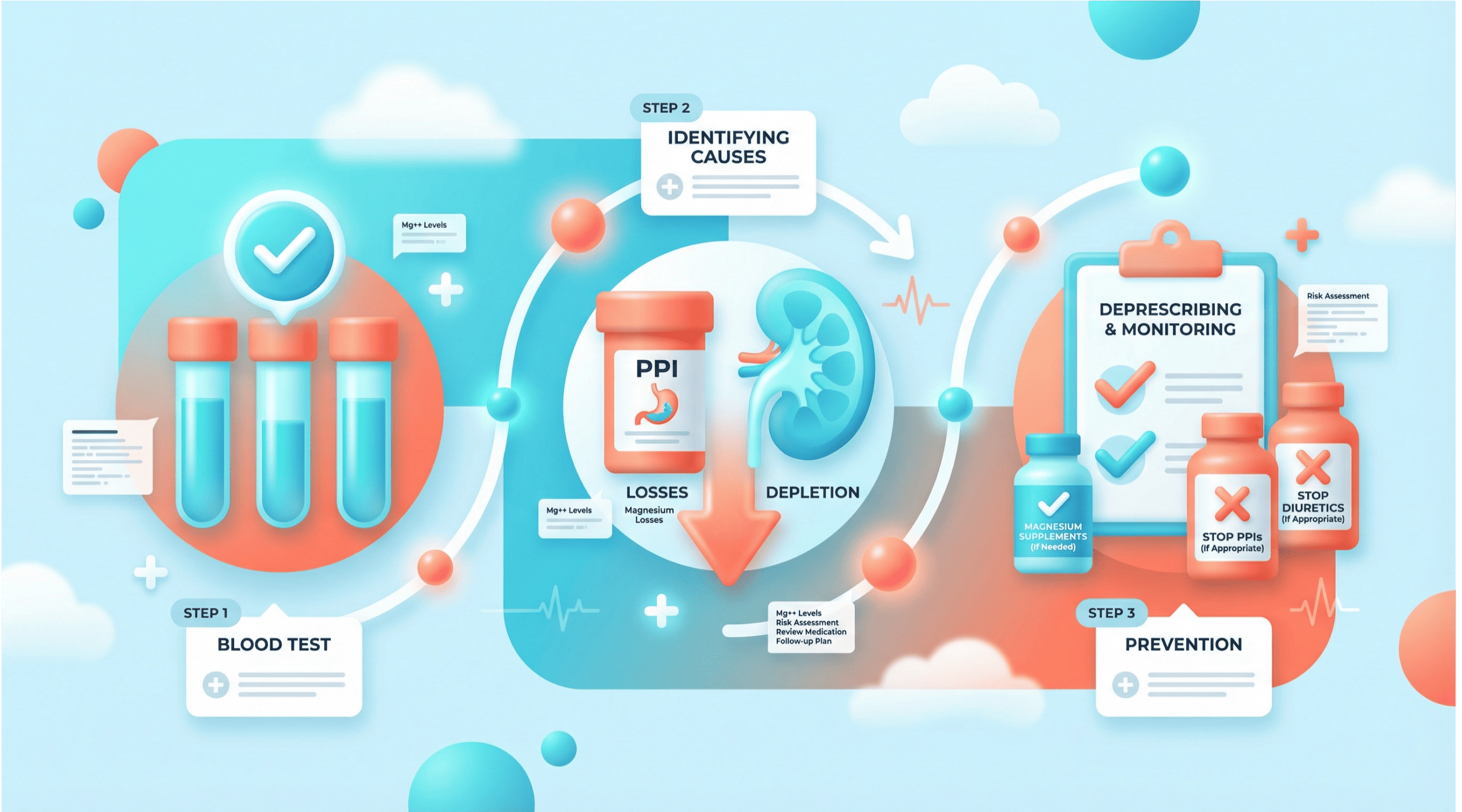
Magnesium monitoring in primary care should focus on confirming response to replacement, identifying ongoing causes such as continued PPI use or renal losses, and preventing recurrence through medication review and deprescribing where appropriate.

  • Confirming response to replacement
  • Identifying ongoing causes such as continued PPI use or renal losses
  • Preventing recurrence through medication review and deprescribing where appropriate
Testosterone levels, kidney health, medication reviews, and long-term condition support for UK primary care.
Abstract digital healthcare background featuring heart rate monitor and data graphics.

A simple approach to magnesium monitoring in primary care

  • Baseline: Check magnesium before starting long-term PPI therapy
  • At-risk patients: Repeat periodically in those on PPIs, diuretics, or digoxin
  • After replacement: Recheck at 7 days, then at 1-3 months
  • Ongoing risk: Review annually if the underlying cause persists

Recheck serum magnesium 7 days after starting oral treatment and again at 1-3 months depending on the cause. Monitor calcium and potassium, as deficiencies often coexist.

In patients with renal impairment (CKD 4-5, AKI, or dialysis), seek specialist advice before initiating replacement due to hypermagnesaemia risk.

FAQs

Need support with medication reviews?

For patients asking about over-the-counter supplements, including magnesium glycinate, see our guide to magnesium glycinate. For clinical guidance, refer to NHS SPS and the MHRA Drug Safety Update.

Illustration showing structured medication reviews for long-term conditions in primary care, with heart and lungs connected by care pathways

A Practical Guide to Structured Medication Reviews (SMR) for Long-Term Conditions

Structured medication reviews (SMRs) are a structured, person-centred review of medicines for people living with long-term conditions in primary care. They move clinicians beyond routine prescription checks and into meaningful conversations about safety, outcomes and what matters most to patients. As medicines accumulate over time, the risk of treatment burden and medicines-related harm increases without regular review. SMRs provide a clear, repeatable framework to manage this safely and consistently across Primary Care Networks (PCNs).

Why reviews matter in long-term condition care
Who should be prioritised for an SMR?
The structured medication review checklist
Who delivers SMRs?

Key takeaways

  • Structured medication reviews for long term conditions are not routine reviews – they are in-depth clinical consultations, not administrative checks
  • Risk matters more than volume – patients with complex needs and polypharmacy benefit most
  • Clear governance enables impact – pharmacist prescribers prevent work drifting back to GPs
Illustration showing heart and lungs representing long-term conditions managed in primary care
Long-term conditions often require regular structured medication review

Why reviews matter in long-term condition care

Structured medication reviews support effective long-term condition management in primary care by enabling safer prescribing for complex patients. People with chronic illness are more likely to experience prescribing cascades and cumulative side effects.

In practice, structured medication reviews for long term conditions provide a clinical framework for reviewing complex prescribing in people with multiple long-term conditions. A focused structured medication review LTC creates protected time to reassess treatment rather than continuing historic prescribing by default.

A structured medication review is only valuable if it leads to real clinical decisions. When reviews focus on risk, outcomes and patient priorities, they reduce harm and prevent work recycling back to already stretched GP teams.

Adeem Azhar, Co-Founder and Chief Executive Officer – Core Prescribing Solutions

Diagram showing the clinical flow of structured medication reviews for long-term conditions
(click the graphic to see in higher resolution)
How structured medication reviews work for long-term conditions

Who should be prioritised for an SMR?

SMRs should be targeted based on clinical risk rather than age alone. A targeted polypharmacy medication review is most beneficial for patients who:

  • Live with multiple long-term conditions
  • Take several regular medicines with high treatment burden
  • Are at increased risk of harm, such as falls or renal impairment
  • Use high-risk medicines, including anticoagulants or lithium
  • Have had a recent medicines-related hospital admission

This approach helps GP practices and PCNs focus capacity where it delivers the greatest population benefit.

The structured medication review checklist

To ensure safety and consistency, an SMR GP practice should follow a clear clinical pathway. Many teams use a structured medication review checklist to guide consultations:

  • Patient priorities
  • Indication and benefit
  • Safety and monitoring
  • Adherence
  • Deprescribing opportunities

This aligns with NICE guidance on medicines optimisation and supports clear clinical decisions.

Safety and deprescribing in long-term conditions

Polypharmacy is common in chronic illness, but more medicines do not always mean better outcomes. A structured polypharmacy medication review helps reduce cumulative risk, simplify regimens and plan deprescribing safely, improving adherence and reducing avoidable harm.

Who delivers SMRs?

Structured medication reviews can be delivered by GPs or clinical pharmacists. In many practices, pharmacist prescribers add the greatest value by making real-time prescribing decisions without unnecessary hand-offs. Clear governance ensures reviews translate into action rather than additional GP workload.

FAQs

Are SMRs a challenge?

Copyright 2026.