Skip to main content


 01274 442076


Changing Clinical Pharmacy Providers: TUPE, DPIA and a Safe Transition Checklist for PCNs
|
Getting your Trinity Audio player ready...
|
- What should a PCN pharmacy service handover checklist include?
- Does TUPE apply when changing clinical pharmacy providers?
- Looking for support with a clinical pharmacy provider transition?
- When is a DPIA required during a clinical pharmacy provider transition?
- What does a phased transition timeline look like?
- How should governance and supervision work during mobilisation?
- How can Core Prescribing Solutions support the transition?
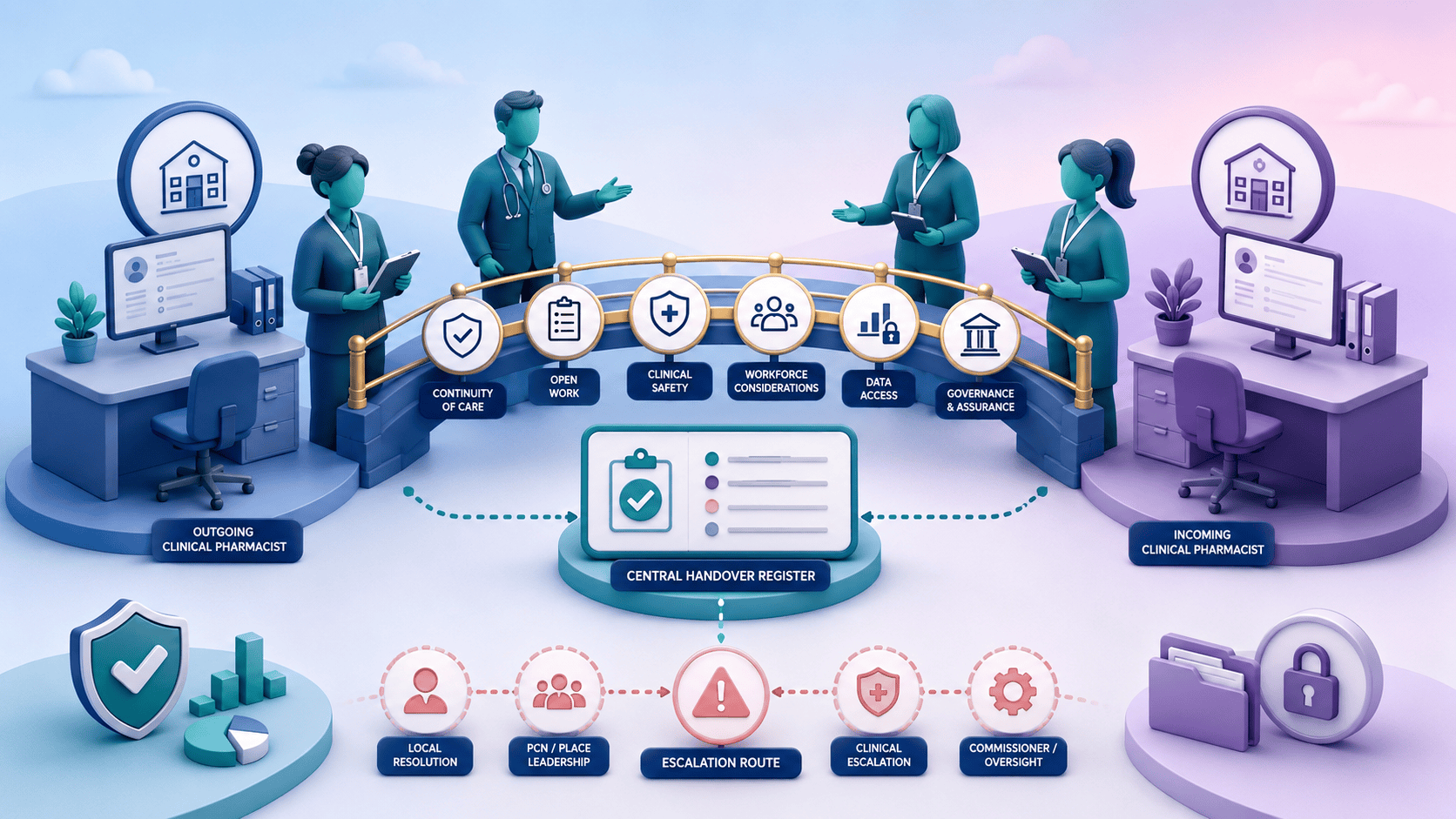
Changing clinical pharmacy providers safely requires a controlled handover of patient work, accountability, workforce and data access. Before mobilisation, relevant organisations should agree named leads and escalation routes.
Key takeaways
- Continuity needs named owners: Open work, high-risk medicines monitoring and escalation need clear accountability.
- TUPE is fact-specific: A contract moving to a new provider can be a service provision change; obtain specialist advice early.
- Data protection needs a recorded decision: The relevant controller or controllers should review existing DPIA arrangements.
A safe clinical pharmacy service transition has five steps:
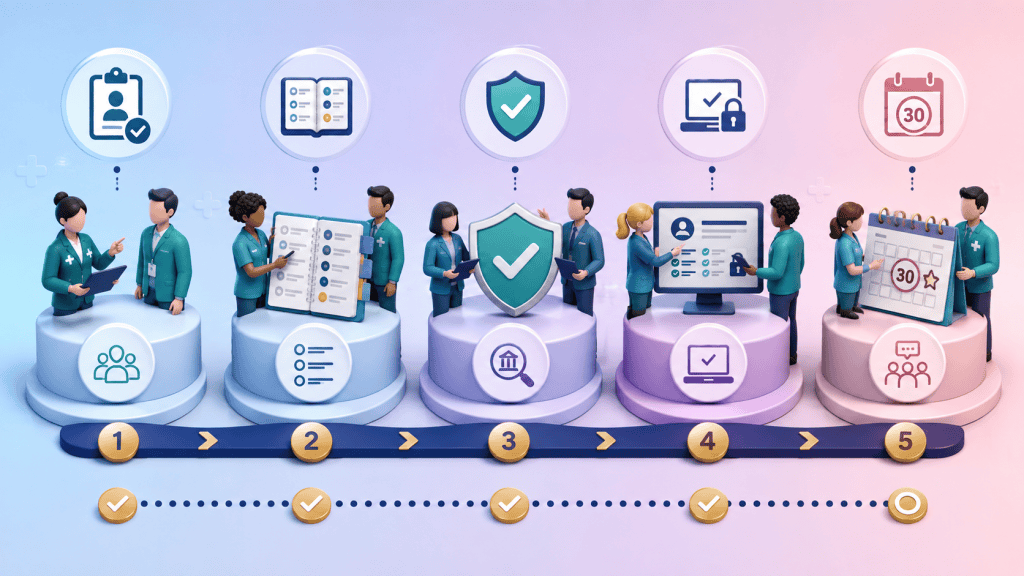
- Appoint leads for clinical safety, workforce, operations and information governance.
- Reconcile open work in one register with owners, status, deadlines and escalation.
- Complete due diligence on competence, supervision, systems, data controls and reporting.
- Test mobilisation through access, induction and escalation exercises.
- Review at 30 days to resolve gaps and confirm continuity.
What should a PCN pharmacy service handover checklist include?
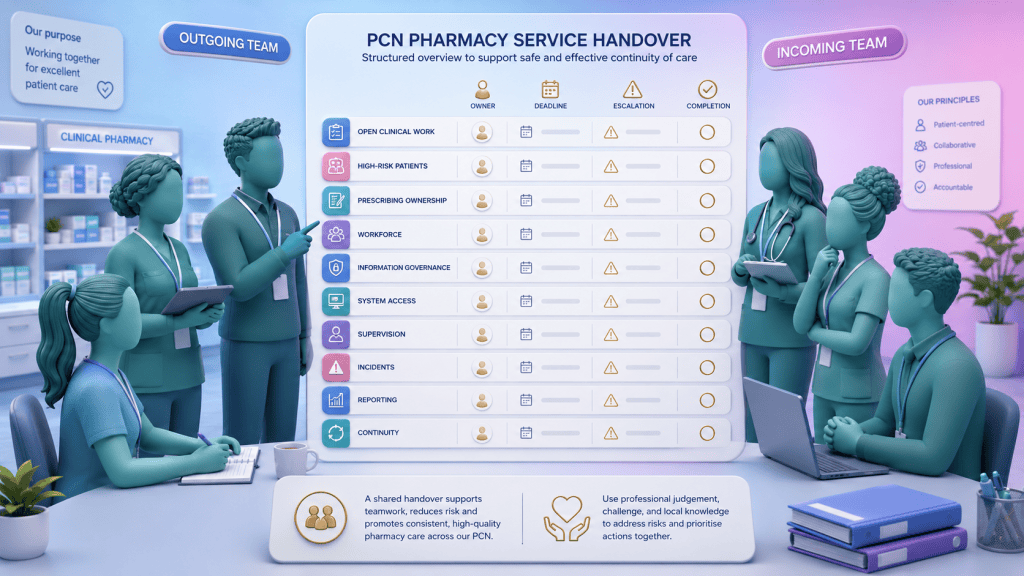
Use this PCN pharmacy service handover checklist to structure discussion between outgoing and incoming providers and practices.
| Area | Transition check |
|---|---|
| Clinical work | Open tasks have an owner, status and deadline. |
| High-risk patients | Monitoring, results and urgent follow-up are identified. |
| Prescribing | Responsibility and escalation routes are documented. |
| Workforce | Appropriate advisers review the potential TUPE position. |
| Information governance | Confirm controller or controllers, processors and data flows. |
| System access | Test incoming access and schedule access removal. |
| Supervision | Agree named supervisors and review frequency. |
| Incidents | Transfer open investigations, complaints and actions. |
| Reporting | Agree baselines and first-month reporting. |
| Continuity | Test absence and delayed-access contingencies. |
Does TUPE apply when changing clinical pharmacy providers?

A TUPE service provision change may apply when a contract ends and a new contractor takes over. A TUPE service provision change needs an early review of the service, assigned staff and consultation timetable. Under GOV.UK’s TUPE guidance, staff identified as providing the transferred service may be protected, but the result depends on the facts.
Obtain employment and legal advice before communicating decisions.
Looking for support with a clinical pharmacy provider transition?
If your PCN is changing clinical pharmacy providers, explore our Clinical Pharmacist Support Service. Ask us to review your transition plan.
When is a DPIA required during a clinical pharmacy provider transition?
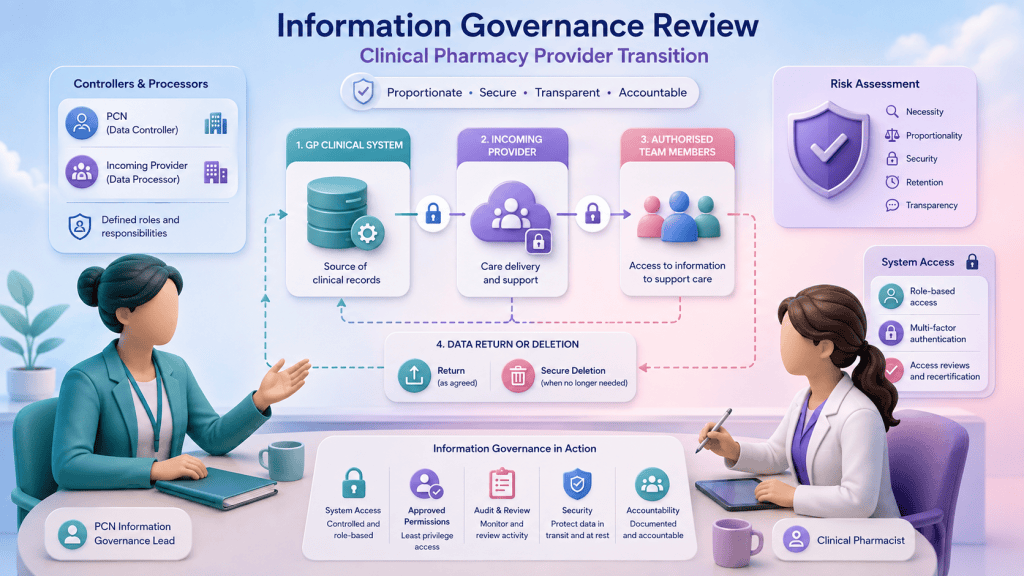
Changing provider does not automatically require a new DPIA. When is a DPIA required? The ICO’s guidance says the relevant controller or controllers should assess whether revised processing is likely to result in high risk, especially if systems, access, data flows or processors change.
During the clinical pharmacy service transition, record the decision, controls, approved access and data return or deletion.
What does a phased transition timeline look like?
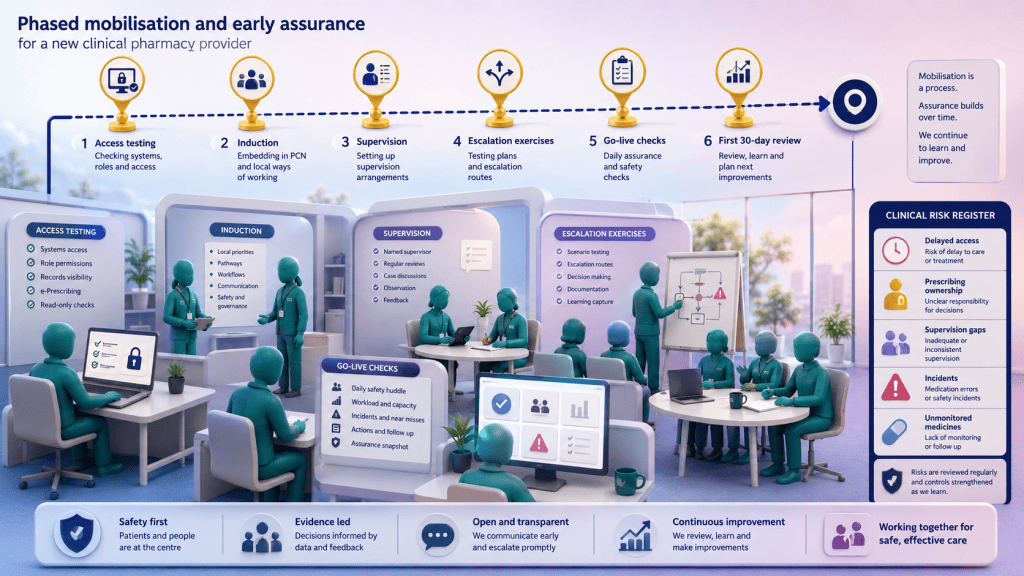
| Phase | Priority actions |
|---|---|
| 6–8 weeks before | Confirm contract, workforce, TUPE, data and governance arrangements. |
| 4 weeks before | Complete onboarding, access, workflow mapping and supervision plans. |
| 2 weeks before | Reconcile open work and test escalation routes. |
| Go-live | Run daily operational and clinical-safety checks. |
| First 30 days | Review records, incidents, activity, feedback and outstanding actions. |
How should governance and supervision work during mobilisation?
Use a register for incomplete handovers, delayed access, prescribing ownership, supervision gaps and unmonitored medicines. This clinical risk management supports CQC Regulation 17 expectations for risk assessment, monitoring and mitigation.
The provider should evidence capacity, competence, induction and supervision. NHS England says says practices and PCNs should assure themselves about staff competence and supervisory arrangements.
Expert insight from Adeem Azhar, qualified Clinical Pharmacist and CEO
A safe transition depends on visible clinical ownership. When teams agree the handover register, escalation routes and standards before go-live, they protect continuity while the new service embeds.
Adeem Azhar, MPharm, IPres
Co-Founder and Chief Executive Officer – Core Prescribing Solutions
Qualified Clinical Pharmacist
Editorial note: obtain Adeem Azhar’s approval for the drafted quotation before publication.
How can Core Prescribing Solutions support the transition?
Core Prescribing Solutions can support discovery, risk review, open-work reconciliation, workflow mapping, clinical-system onboarding, governance, phased mobilisation, continuity cover and early reporting. This helps PCNs when outsourcing becomes appropriate or to compare clinical pharmacy delivery models.
FAQs
Looking for support with a clinical pharmacy provider transition?
If your PCN is changing clinical pharmacy providers, explore our Clinical Pharmacist Support Service.