Latest News and Info

Data-led workforce planning across a primary care network showing capacity, demand and ARRS roles

Use Workforce Data to Improve ARRS Workforce Planning

Using workforce data for ARRS workforce planning means analysing delivered full-time equivalent (FTE), activity, utilisation and demand trends to decide which ARRS roles are needed, where they should be deployed, and why. For Primary Care Networks (PCNs), this data-led approach replaces reactive recruitment with purposeful planning based on real workload, population need and system pressure. By understanding how roles are actually used – rather than how they are funded or intended – PCNs can design an ARRS workforce that reduces GP workload, improves consistency across practices and delivers long-term value rather than short-term relief.

Key Takeaways

  • Workforce data shows how ARRS roles are actually being used, including FTE delivered, utilisation and demand, not just how they are funded.
  • Data-led workforce planning improves decisions about which ARRS roles to recruit, where to deploy them and how to balance skill mix across a PCN.
  • Using workforce analytics and forecasting prevents common problems such as underutilised roles, rising GP workload and reactive recruitment cycles.

Why Workforce Planning Matters in Primary Care

Most PCNs manage increasing demand, complex patients and variation across practices. Without accurate information about capacity, ARRS roles can feel disconnected from day-to-day pressures. Effective workforce planning provides structure, reduces uncertainty and replaces annual cycles of reactive decision making. Workforce planning is also shaped by national priorities, with the NHS Long Term Workforce Plan setting out how the system must build a workforce that can meet rising demand while improving long-term capacity.

Good planning helps PCNs:

  • match roles to population health need
  • quantify available clinical workforce capacity
  • redistribute tasks to reduce GP workload
  • demonstrate the impact of workforce changes
  • prepare for future service requirements and DES priorities

This clarity strengthens NHS workforce planning and ensures decisions are defensible, fair and aligned with current and future demand.

Illustration showing the balance between workforce capacity and patient demand in primary care

What commonly goes wrong without workforce data

When workforce planning is not guided by clear data, ARRS investment often fails to translate into reduced workload or improved service delivery. PCNs frequently experience the same patterns, regardless of size or population.

Common issues include:

  • Over-recruiting the wrong ARRS rolesRoles are added based on funding availability or short-term pressure rather than actual demand, leading to gaps remaining elsewhere in the system.
  • Underutilised pharmacists and pharmacy techniciansARRS staff may be technically in post but spend large proportions of time on low-impact or poorly defined activity, limiting their contribution to workload reduction.
  • GP workload not reducing despite ARRS growthWithout visibility of activity and outcomes, additional roles do not reliably displace GP work, meaning pressure remains unchanged.
  • Informal gap-filling without governanceARRS roles often drift into covering immediate needs without clear scope, job planning or performance measures, creating inconsistency and risk.
  • Reactive recruitment cyclesDecisions are driven by crises rather than planning, resulting in repeated hiring, role redesign and frustration across practices.

This is why workforce analytics, forecasting and capacity modelling are not optional extras. They provide the structure needed to turn ARRS funding into measurable workforce impact.

What Workforce Analytics Reveals for ARRS Teams

Many PCNs hold large amounts of data but lack the insight needed to interpret it. Workforce analytics transforms numbers into actionable intelligence, enabling leaders to understand workforce behaviour and make informed decisions.

Workforce analytics provides visibility of:

  • actual full time equivalent (FTE) delivered across ARRS roles
  • where workload is rising before it becomes a risk
  • time spent on clinical and non clinical tasks
  • the effect of roles on GP appointment volume
  • variation in demand across sites or days
  • recruitment and retention rates

This level of insight supports more accurate PCN capacity planning and allows leaders to identify priority areas. It also forms the foundation for more advanced planning approaches, including workforce forecasting and capacity and demand modelling.

Workforce analytics dashboard showing utilisation, FTE and performance across ARRS roles

Workforce Planning Tools That Make Decisions Easier

Workforce planning tools help consolidate information into a single, accessible view. PCN managers and PCN Clinical Directors often spend significant time gathering data from disparate systems. Simple, practical tools reduce this administrative burden and support clearer decision making.

Useful features include:

  • dashboards showing FTE, vacancies and utilisation
  • demand and capacity reports based on appointment data
  • heat maps to highlight high-pressure areas
  • automated alerts for emerging gaps
  • comparisons across practices or demographic groups

These tools enhance the quality of workforce planning by making information easier to interpret. They also support more consistent decision making across the network.

Workforce planning tools dashboard with capacity tracking, alerts and demand visualisation

Workforce Forecasting: Planning Next Year’s Workforce Now

Workforce forecasting brings together FTE, appointment activity, population health trends, patient and practice needs along with demand patterns to project what the workforce will need in the future. This gives PCNs greater control over planning cycles and reduces reliance on short-term fixes. Resources from Health Education England highlight how workforce analytics and structured planning approaches support better decisions, enabling PCNs to anticipate future pressures and design a workforce that is responsive to population need.

Effective forecasting helps PCNs:

  • identify which additional ARRS roles are required
  • anticipate seasonal variation or long-term increases in demand
  • plan for GP retirements or changes in capacity and turnover in clinical staff
  • adjust the skill mix to meet future needs
  • justify requests for support to the ICB

Primary care workforce forecasting provides structure and predictability. It allows PCNs to act early and avoid last-minute recruitment decisions.

Workforce forecasting illustration showing future capacity planning in primary care

Capacity and Demand Modelling: Matching Workload to Workforce

Capacity and demand modelling helps PCNs understand where pressure is building and how workload compares to the workforce available. This aligns with NHS England’s wider demand and capacity principles, which emphasise the importance of matching system demand with sustainable workforce capacity.

 Most PCNs encounter bottlenecks caused by rising demand across same-day access, long-term condition management and home visiting.

Modelling helps identify:

  • same-day access pressure points
  • increasing demand in long-term condition pathways
  • growth in home visiting requirements
  • population groups that require additional support
  • future service delivery needs

This supports realistic workforce planning and prevents overreliance on existing staff. It also strengthens evidence for recruitment decisions and ensures ARRS roles are positioned where they deliver the greatest impact.

Capacity and demand modelling with predictive analytics showing future workforce pressure points

How Predictive Analytics Strengthens Workforce Decisions

Advanced predictive analytics healthcare tools take planning a step further by identifying future challenges based on historic trends. While standard reporting tells you what happened yesterday, predictive models allow PCNs to prepare for emerging pressures before they materialise.

Predictive analytics can reveal:

  • clinics likely to experience pressure months ahead
  • emerging mental health or frailty needs based on population data
  • the potential effect of rising long-term conditions on workforce load
  • which ARRS roles offer the strongest long-term value

By integrating these insights, PCNs can enhance both planning and operational delivery, building a workforce strategy that is prepared for tomorrow as well as today.

Turning Data into ARRS Workforce Optimisation

The value of data lies in how it informs day-to-day decisions. ARRS workforce optimisation focuses on structuring roles effectively, reducing duplication and improving the balance between clinical and non clinical activity.

Optimisation helps PCNs:

  • refine skill mix and reduce variation across sites
  • shift tasks to the right professional at the right time
  • improve retention through clearer expectations
  • achieve more consistent service delivery
  • build a workforce aligned to population need

Networks that adopt data-led optimisation typically see better workload distribution, clearer job planning and improved use of ARRS roles.

Expert Insight

When PCNs, GP Practices and GP Federations understand their real workforce capacity and demand patterns based on practice and patient needs, decision making becomes clearer. Data gives leaders the confidence to design a workforce that fits their population. ARRS clinical  roles deliver far more value when they are planned, monitored and adjusted through insight rather than pressure.

Adeem Azhar, Co-Founder and Chief Executive Officer – Core Prescribing Solutions

FAQs

Ready to move from reactive recruitment to data-led strategy?

Stop guessing with your ARRS funding. Book a consultation with our team today to see how our workforce planning tools can give you full visibility over your PCN’s capacity and demand.

ARRS roles 2025/26 funding explained

How to Use the Additional Roles Reimbursement Scheme (ARRS) Strategically in Your PCN

The Additional Roles Reimbursement Scheme (ARRS) has transformed primary care by allowing Primary Care Networks (PCNs) to expand their multidisciplinary teams. From clinical pharmacists to First Contact Practitioners, thousands of professionals are now delivering care in new and flexible ways.

For ARRS roles 2025/26, the scheme changed significantly. Funding is now pooled into a single, flexible reimbursement pot with no role caps, and both GPs and practice nurses are now eligible for reimbursement. For PCNs, this is a turning point – it’s no longer about filling quotas; it’s about designing teams around services and outcomes.

“The networks seeing the biggest impact from ARRS are the ones designing services around outcomes and their patients, not job titles. When you start with what patients need – and then shape the workforce to deliver it – the value of ARRS funding really comes to life.”

– Adeem Azhar, CEO, Core Prescribing Solutions

3 Key Takeaways

  1. ARRS flexibility enables true workforce design – no role caps, wider eligibility, and service-driven planning.
  2. Service-first thinking beats role shopping – focus on outcomes like access, long-term condition management, and frailty care.
  3. Governance and ARRS ROI (return on investment) are essential – supervision, compliance, and measurable data ensure ARRS delivers lasting value.

What the ARRS roles 2025/26 Changes Mean for PCNs

Here are the major updates every PCN leader needs to know (see the official NHS England ARRS guidance for full details):

  • Single pot, no caps – PCNs can choose the mix of roles that best meet patient demand.
  • New eligibility – Newly qualified GPs and practice nurses are now included.
  • Claims process – new roles are reimbursed through the ARRS Claims Portal under the “Other Direct Patient Care” category.
  • Expanded nursing routes – enhanced practice nurses and advanced practitioner pathways included.

The ARRS Claims Portal continues to play a key role in reimbursement tracking – ensuring networks can claim efficiently while maintaining governance and financial accuracy.

Step 1: Start with Service Mapping

The old question was “What ARRS roles can we fill?”

The smarter question is:

  • Which clinical services create the biggest pressure (urgent access, long-term conditions, frailty)?
  • What skills are needed to deliver them?
  • How do those skills map to ARRS workforce planning priorities and reimbursement categories?

For many PCNs, ARRS has become the foundation of primary care workforce planning – enabling smarter, data-driven service design.

Step 2: Build Proven Workforce Models

High-performing networks use ARRS funding to create service-first workforce models such as:

  • Urgent access hubs: paramedics, ANPs, and care coordinators reducing same-day pressure.
  • Condition-led clinics: pharmacists and pharmacy technicians managing diabetes or polypharmacy workloads.
  • Frailty teams: nurses and physician associates supporting proactive home visits.
  • MSK first contact: physiotherapists resolving musculoskeletal cases early.
  • Personalised care trios: link workers, health coaches, and coordinators improving activation and prevention.

Each model should tie directly to measurable patient outcomes and QOF/LTC performance metrics.

nfographic showing connected workforce models around a central PCN Services hub, including urgent care, long-term condition management, frailty, and personalised care.

Step 3: Link to Measurable Outcomes

For every service model, PCNs should measure:

  • GP time released (hours per week)
  • Appointments redirected from same-day triage
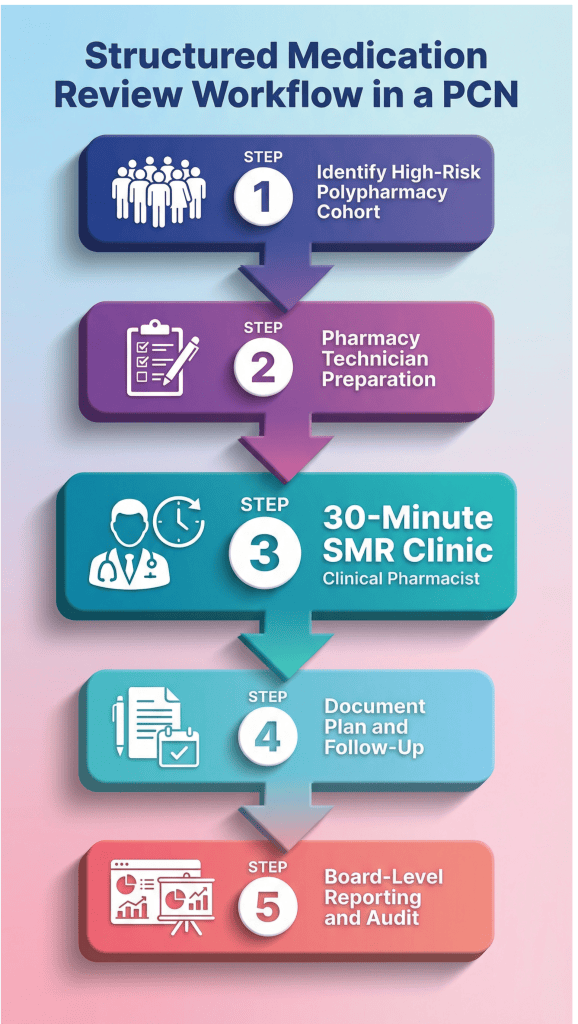
  • Structured medication reviews completed
  • Patient satisfaction and access data

When monitored consistently, ARRS becomes a strategic investment, not just a workforce subsidy.

Governance, Supervision & Compliance

Flexibility demands structure. Without clear supervision, ARRS workforce planning can falter.

Networks should:

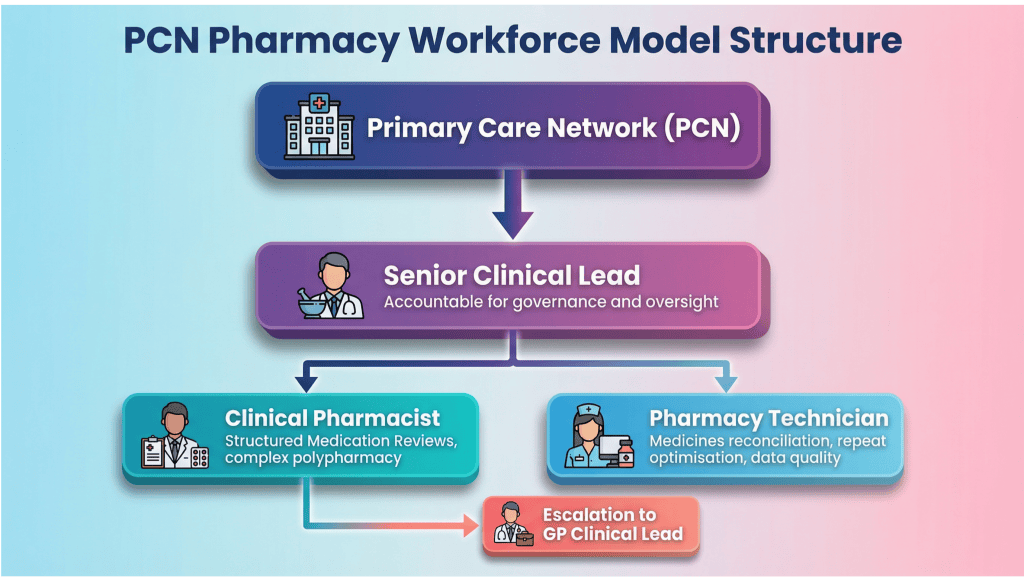
  • Define accountability lines for every role
  • Use structured induction and supervision frameworks
  • Set escalation pathways and review performance monthly
  • Capture incident data and apply learning

The Additional Roles Reimbursement Scheme (ARRS) gives PCNs greater flexibility, but this flexibility must be matched with strong governance and clinical oversight to maintain quality and safety.

For guidance on structuring governance and supervision, see our ARRS Support Services page.

Multi-coloured ARRS medical icons with stethoscope and charts, promoting core prescribing solutions for ARR management.

Making the Money Work: Demonstrating ARRS ROI (return on investment)

The ARRS ROI (return on investment) conversation is critical in 2025/26. ARRS funding is generous, but underused or poorly planned roles risk inefficiency.

To evidence ROI, networks should:

  • Model the full ARRS pot and forecast spend by service line.
  • Tie every role to measurable outcomes and access targets.
  • Benchmark against national NHS ARRS uptake data.

Our team helps PCNs translate these metrics into tangible savings and performance improvements – ensuring ARRS remains financially and clinically sustainable.

ARRS ROI visual with data charts, graphs, and performance metrics illustrating workforce value, efficiency, and measurable outcomes for primary care networks.

Building Progression and Long-Term Value

ARRS isn’t just about today’s workload. The scheme should underpin career progression and workforce stability.

Enhanced practice nurse and advanced practitioner pathways allow PCNs to grow advanced capacity in-house, reducing reliance on locums and agency staffing.

By investing in supervision, upskilling, and structured reviews, PCNs can retain talent and continuously improve care quality.

Healthcare professionals collaborating around a presentation showing growth and innovation, representing workforce development, mentorship, and sustainable primary care progression.

Turning Strategy into Action

Even the best workforce models fail without consistent implementation. To deliver at scale:

  • Communicate clearly across practices about ARRS roles and responsibilities.
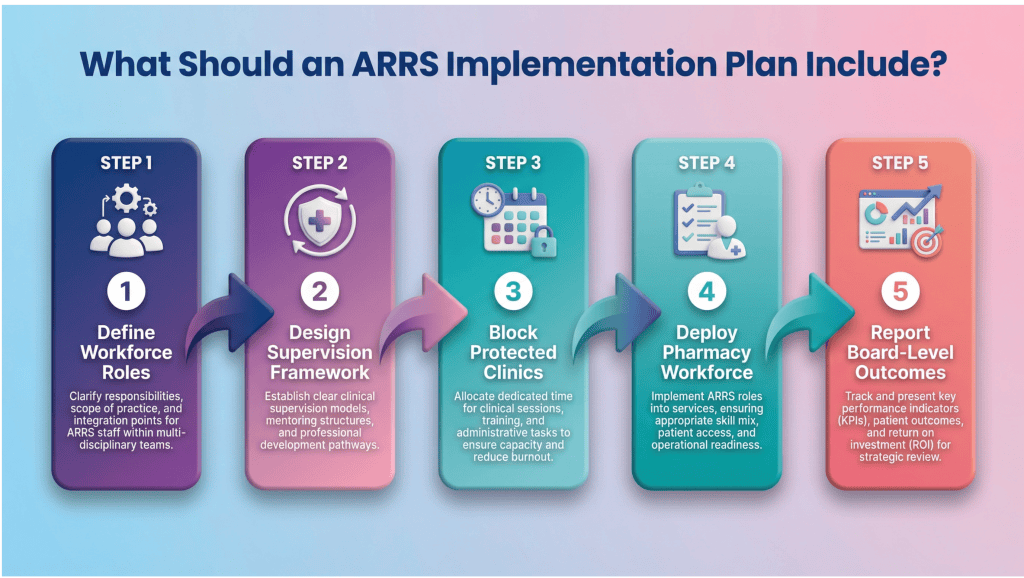
  • Define scope through SOPs and supervision frameworks.
  • Use digital dashboards to track outcomes and adjust monthly.

Frequently Asked Questions

Book a free 30-minute ARRS workforce review with our team to unlock the full potential of your network’s funding.

Visit our ARRS Support Services page to get started.

Copyright 2026.