Skip to main content


 01274 442076



QOF Register Management Support for GP Practices: What Good Looks Like
|
Getting your Trinity Audio player ready...
|
- What is a QOF register, and how does it differ from an indicator denominator?
- What does good QOF register management look like?
- What does this look like for one flagged record?
- Why do annual QOF business-rule changes require a register review?
- When is external register-review support useful?
- What should a practice receive from the service?
- What should a practice ask before commissioning QOF support?
QOF register management support gives GP practices a disciplined way to check whether QOF cohorts reflect the current record, direct genuine gaps to the right reviewer and make sure agreed actions are completed. It is not a mechanism for increasing prevalence figures. It is a practical control for accurate records, appropriate patient follow-up and reliable reporting.
For practice leaders, the test is simple: can the practice explain how a possible gap moves from a search result to a documented decision, an appropriate action or a safe handover? NHS England says contractors must have systems to maintain high-quality, accurate registers. It also cautions that QOF registers must not be the sole input for patient care or clinical audit.QOF guidance for 2026/27
Key takeaways
- A QOF register is a defined cohort: It differs from an indicator denominator and from a patient recall list.
- A search result is a prompt, not a diagnosis: Findings require review against the record and current criteria.
- Good support completes a controlled pathway: It establishes ownership, escalation and a useful handover rather than only producing a dashboard.
- The right measure is explained accuracy: A change in recorded prevalence should be understood and evidenced, not simply celebrated.
What is a QOF register, and how does it differ from an indicator denominator?

A QOF register is the defined population that meets the relevant criteria in the current business rules. Depending on the measure, those criteria may use predetermined clinical codes or patient attributes such as age and sex. QOF guidance for 2026/27
The distinction matters because the four terms below answer different operational questions. Treating them as interchangeable can create misleading reports, duplicate recalls and poorly targeted work.
| Term | What it means in practice | Why a practice should distinguish it |
|---|---|---|
| QOF disease register | The defined cohort for a condition or risk factor. | It informs recorded prevalence and may supply patients to indicator logic. |
| Indicator denominator | Patients eligible for one specific indicator. | It may be narrower than the register because of dates, age or other logic. |
| Indicator numerator | Denominator patients with the specified intervention or outcome recorded. | It is used to calculate achievement for that indicator. |
| Personalised care adjustment (PCA) | A documented, patient-specific adjustment under current rules. | It affects the relevant indicator calculation; it does not remove a patient from the disease register. |
QOF prevalence is recorded prevalence, not an estimate of true population prevalence. NHS England’s data-quality annex says QOF clinical registers may differ from epidemiological definitions and may not cover all ages. Comparisons with local or expected prevalence therefore need the current definitions and coded business rules in view. QOF 2025–26 data-quality annex
What does good QOF register management look like?

Good QOF register management is a year-round operating routine, not a last-minute coding exercise. The following six steps keep the process clear without making the register a substitute for wider clinical recall.
- Agree the scope. Name the accountable clinical lead. Define the registers, sites, review period and QOF business-rule version in scope. Confirm who reviews evidence, who can make or authorise a record change and how uncertainty is escalated.
- Set a baseline. Record the list size, register count, relevant denominator, recorded QOF prevalence and open work. Comparison data can help prioritise review, but it cannot replace patient-level evidence.
- Run reproducible searches. Search results may use coding, registration history, correspondence, medicines, observations or tests. Label the output as a review list. It is not a list of confirmed diagnoses.
- Review the record and decide. An appropriately qualified reviewer checks the available clinical evidence, the relevant criteria and the current status. The outcome may be a justified record update, no change, a request for further information or escalation to the appropriate clinician.
- Route any follow-up. A validated record may reveal an indicator gap or a wider care need. The next step might be monitoring, a recall, a review or no further action. Where medicines complexity is central, that work may sit within a structured medication review.
- Report, hand over and repeat. Track each worklist to a clear outcome. Record unresolved cases, their owner and escalation route. Revisit the process after a data migration, merger, rule change or recurring coding issue.
This approach makes it easier to explain why a register changed. It also separates data-quality work from indicator delivery. For support focused on reviews, recalls and action against indicators after the register is understood, see Core Prescribing Solutions’ article on pharmacist-led QOF delivery.
Need capacity to turn QOF worklists into accountable follow-through?
Discuss QOF register supportWhat does this look like for one flagged record?

The example below is illustrative. It is not a diagnostic protocol, a universal code list or a substitute for clinical judgement.
A practice runs a reproducible search while reviewing a condition-specific register. One record is flagged because historic correspondence appears to describe a diagnosis, but the current record does not show the qualifying entry used by the relevant QOF logic.
First, the reviewer checks the correspondence, the date and source of the evidence, the current record and the applicable register criteria. If the evidence and criteria support the entry, the agreed clinician records the appropriate update and the rationale is retained. If the evidence is inconclusive, the record remains unchanged and is escalated or placed on a defined review pathway. If the diagnosis is already supported but the person has an outstanding clinical need, that action is routed separately rather than assumed from the register alone.
The worklist is then closed only when its status is visible. The practice can see whether the record was updated, left unchanged, escalated or moved into an agreed follow-up pathway. This is the practical difference between a search that finds possible gaps and a managed register review that produces accountable outcomes.
| Illustrative reporting field | Example status | What the report should show |
|---|---|---|
| Records flagged by the search | 48 | Search version, run date and inclusion logic. |
| Record review completed | 36 | Reviewer, evidence source and decision date. |
| Record updated | 9 | Rationale and relevant audit trail. |
| No change after review | 18 | Reason the current record remains appropriate. |
| Escalated or awaiting evidence | 9 | Named owner, next step and review date. |
| Follow-up action created | 7 | Action type, owner and completion status. |
The figures are illustrative only. They are not a benchmark, a promise of yield or evidence that a register should grow.
Why do annual QOF business-rule changes require a register review?
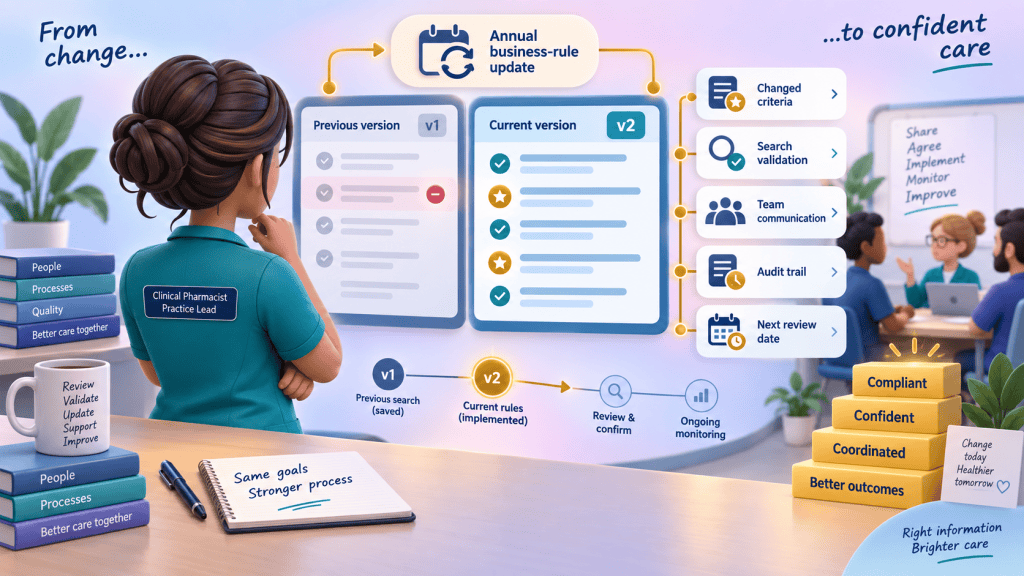
Annual rule changes can make a reliable historic search or local code list incomplete. NHS England Digital states that QOF indicators may be introduced, changed or retired each year. The current release is QOF business rules v51 2026, last edited on 17 July 2026.
For 2026/27, NHS England describes a revised COPD register intended to improve accuracy through code changes that address potential under-recording and over-recording.QOF guidance for 2026/27 The useful operational response is not to recreate every indicator in a local document. It is to record the applicable rule version, assess the impact on existing searches, revise them where required and tell the team what has changed.
When is external register-review support useful?
External QOF register management support is most useful when a practice has a credible review list but lacks capacity to validate, action and hand over the work consistently. Common triggers include a data migration, a merger, a large correspondence backlog, mixed coding approaches across sites or a search process that repeatedly creates worklists without resolving them.
Core Prescribing Solutions’ published Clinical Pharmacist Support Service provides managed, governance-led pharmacist support for GP practices, PCNs and federations. It can be delivered in-practice, remotely or through a hybrid model. Its published service areas include audit, QOF and prescribing governance, medicines optimisation and structured medication reviews, repeat-prescribing and medicines-safety processes, and workflow improvement.
For a register-review project, a practice should agree the exact scope before work begins. A clear specification should state which cohorts are in scope; which rule version and search logic will be used; who reviews records; which agreed actions the pharmacy team can progress; which decisions remain with the practice; how access, confidentiality and audit trails are managed; and how unresolved cases return to a named local owner.
That clarity gives the buyer a meaningful description of the service. The practice receives defined clinical pharmacy capacity and an agreed operating method. The practice contributes local clinical governance, access arrangements, contextual knowledge and final decisions within its own arrangements. Unresolved or complex cases should be visible at handover, not hidden inside a completed-work figure.
What should a practice receive from the service?

A QOF register management support specification should state the deliverables before any search is run. It should be short, practical and tailored to the agreed cohort. It should not promise a particular prevalence change, number of points or financial result.
| Workstream | A clear deliverable | What the practice contributes |
|---|---|---|
| Scope and baseline | Agreed cohorts, current QOF business rules, search version and baseline position. | A named clinical lead, local priorities and access arrangements. |
| Review and decision log | Worklists with the review outcome, evidence source, rationale and escalation status. | Local context and decisions that remain with the practice. |
| Appropriate follow-through | Agreed monitoring, review, medicines-safety or recall actions within scope. | A route for appointments, local teams and actions outside the provider’s remit. |
| Reporting and handover | Progress report, unresolved-actions list, named owners and next review date. | Acceptance of the handover and ownership of open cases. |
The table turns a broad offer into an operational agreement. It also makes a provider’s boundaries visible. A QOF register management support project should complement the practice team, not substitute for its clinical governance or wider recall systems.
Record the applicable QOF business rules, the current search version and the next review date. These simple controls make the service repeatable after a rule change or staff transition.
What should a practice ask before commissioning QOF support?
Ask whether the provider can explain the route from search result to final status, rather than only the number of records it can flag. The most useful questions are:
- Which QOF year and business-rule version will be used, and how will updates be controlled?
- What evidence is reviewed before a record is changed, and who makes the final clinical decision?
- Which work can the provider complete within the agreed scope, and which tasks return to the practice?
- How will the provider avoid duplicate recalls and document data access, decisions and escalation?
- What will the report show about updates, no-change decisions, open risks and unresolved actions?
- What does the handover contain, and who owns each outstanding item?
Proposed expert quote – requires Adeem Azhar’s approval
The recurring problem is rarely a lack of data. It is a worklist that identifies a possible issue without a clear clinical route to decide, act or hand it back. Good support closes that gap.
Adeem Azhar, MPharm, IPres
Co-Founder and Chief Executive Officer – Core Prescribing Solutions
Qualified Clinical Pharmacist
FAQs
Turn QOF register reviews into a controlled, accountable workflow
Core Prescribing Solutions can support GP practices and PCNs with defined QOF register-review capacity, Clinical Pharmacist input and governance-led follow-through. We can work with agreed cohorts, search logic and local workflows to support record review, appropriate actions, escalation and clear handover without promising artificial prevalence increases or QOF outcomes.
Discuss your QOF register priorities