Skip to main content


 01274 442076


Understanding the NHS Workforce Plan: What It Means for Primary Care Networks
|
Getting your Trinity Audio player ready...
|
- Five Practical Steps for PCN Workforce Planning
- What is the NHS Long Term Workforce Plan?
- What does the NHS workforce plan mean for PCNs?
- How does ARRS fit into the NHS workforce plan?
- How can PCNs strengthen workforce planning?
The NHS workforce plan is reshaping healthcare across England by supporting a shift towards more community-based, multidisciplinary care. For Primary Care Networks (PCNs), this means moving beyond simple recruitment. PCNs are increasingly expected to optimise skill mix, improve retention and develop integrated services. As patient demand continues to grow, workforce planning has become a strategic priority rather than an operational task. Aligning strategies with the plan’s three pillars – Train, Retain and Reform – helps manage demand and improve clinical outcomes.
Key Takeaways
- Three core pillars: The NHS workforce plan focuses on training, retaining, and reforming teams.
- Community focus: PCNs are central to shifting care closer to communities.
- Multidisciplinary teams: Flexible funding remains a key lever for building multidisciplinary primary care teams.
- Strategic planning: Effective workforce planning must address skill mix, supervision, and ongoing professional development.
Five Practical Steps for PCN Workforce Planning
- Assess your primary care workforce against local population health needs.
- Identify skill gaps and map them to appropriate roles.
- Build robust induction and supervision pathways for new staff.
- Align your team structure with integrated neighbourhood teams.
- Review workforce plans regularly against NHS England guidance.
What is the NHS Long Term Workforce Plan?

Published in 2023, the NHS Long Term Workforce Plan set out the first comprehensive long-term workforce strategy for the NHS in England. Built around three pillars – Train, Retain and Reform – it aims to expand workforce capacity while redesigning how care is delivered across the health service.
The plan aligns with the NHS’s wider shift towards neighbourhood healthcare, encouraging PCNs to work more closely with community providers, pharmacies, social care and wider multidisciplinary teams. This workforce transformation is central to delivering integrated care for an ageing population with increasingly complex health needs.
What does the NHS workforce plan mean for PCNs?
For PCNs, the NHS Long Term Workforce Plan means thinking strategically rather than simply filling vacancies. It encourages practices to develop the right mix of skills, strengthen PCN workforce planning, and improve patient outcomes through collaborative working.
Successful planning starts by understanding local population needs before identifying required skills. This ensures practices recruit professionals who complement existing services while improving access and patient experience. By investing in multidisciplinary primary care, PCNs build resilient services that reduce pressure on GPs.
How does ARRS fit into the NHS workforce plan?

The Additional Roles Reimbursement Scheme (ARRS) supports these developments, giving PCNs flexibility to build teams around local priorities. Modern primary care increasingly relies on multidisciplinary teams working together across practices and Integrated Care Systems.
Clinical pharmacists and pharmacy technicians have become an important part of this approach. They support medicines optimisation, structured medication reviews, and long-term condition management. Allowing each professional to work at the top of their scope of practice improves efficiency and patient care. ARRS funding is a vital mechanism for expanding the multidisciplinary primary care workforce and supporting wider NHS ambitions.
While ARRS provides funding, its success depends on effective workforce planning. Practices need clear role definitions, appropriate supervision and measurable outcomes to ensure new roles deliver lasting value.
How can PCNs strengthen workforce planning?

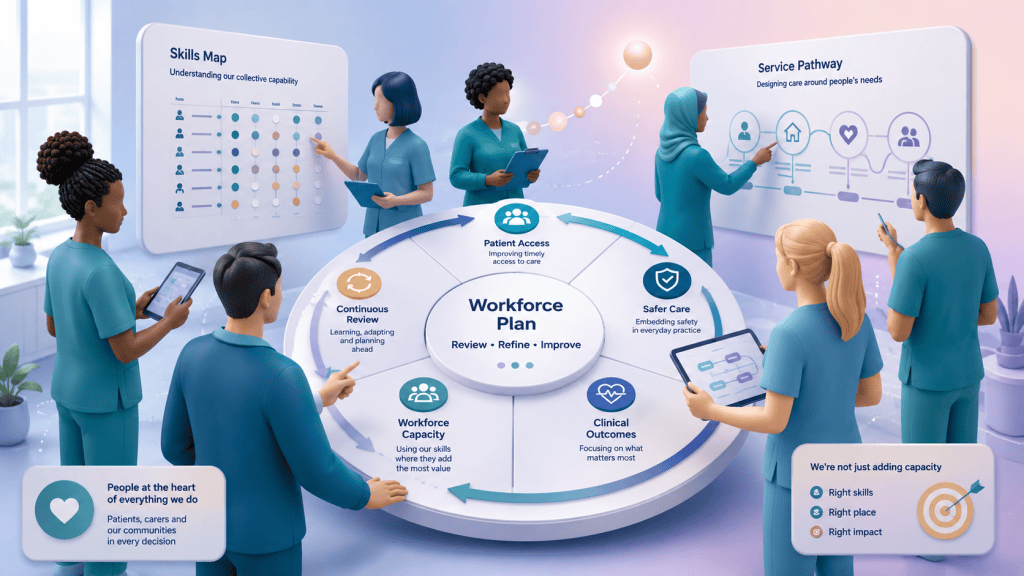
Effective implementation of the NHS workforce plan is closely linked to Quality Improvement (QI). The aim is not simply to recruit more people, but to ensure every role contributes to better patient access, safer care and improved clinical outcomes. Workforce plans should evaluate whether changes are delivering meaningful improvements for patients, staff and the wider primary care workforce.
New roles need effective induction, clinical supervision, and ongoing professional development to deliver lasting benefits. Regular workforce reviews and continuous service improvement ensure teams remain adaptable. Effective recruitment and retention strategies are essential to keep skilled staff within the primary care workforce.
Expert insight from Adeem Azhar, qualified Clinical Pharmacist and CEO
The workforce challenge in primary care cannot be solved through recruitment alone. PCNs need the right blend of clinical skills, clear pathways and effective workforce planning to ensure every role delivers meaningful value for patients and practices alike.
Adeem Azhar, MPharm, IPres
Co-Founder and Chief Executive Officer – Core Prescribing Solutions
Qualified Clinical Pharmacist

FAQs
Need support strengthening your workforce?
Whether you’re developing your workforce strategy, making the most of ARRS funding or expanding your multidisciplinary team, Core Prescribing Solutions provides experienced clinical pharmacists and pharmacy technicians who integrate seamlessly into Primary Care Networks and GP practices to improve patient care.
We work alongside Primary Care Networks to strengthen workforce capacity, improve medicines optimisation and help practices make the most of their multidisciplinary teams.
As this strategy continues to evolve, PCNs that invest in strategic workforce planning today will be better placed to meet future patient demand and support integrated neighbourhood healthcare.