Skip to main content


 01274 442076


PCN DES 2026/27: Network Contract Requirements and Key Changes
Last updated: May 2026. Reviewed against current NHS England 2026/27 Network Contract DES guidance.
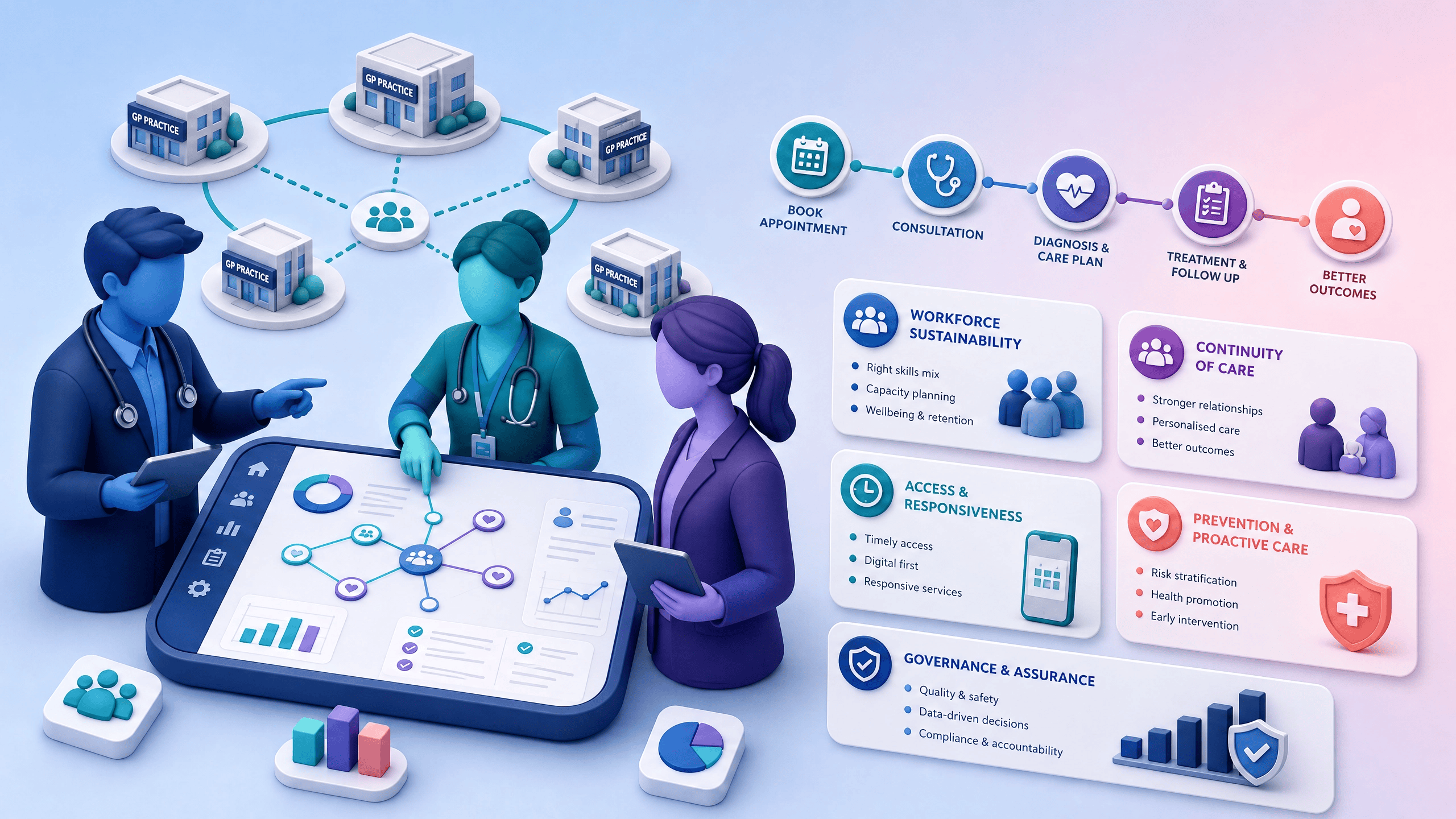
PCN DES 2026/27 sets out how Primary Care Networks are expected to organise workforce, services and patient care under the latest Network Contract DES 26/27. For PCN managers, practice teams and commissioners, the practical challenge is turning contract requirements into safe, measurable patient care.
Key Takeaways
- Delivery focus: PCN DES is shifting from participation and compliance towards operational delivery.
- Workforce flexibility: ARRS remains central, with more flexibility where agreed with the commissioner.
- Patient safety: Continuity, risk stratification and medicines optimisation are key delivery priorities.
- Contract continuity: Many priorities from PCN DES 25/26 remain relevant, alongside new expectations for 2026/27.
What is PCN DES?
PCN DES is the Primary Care Network Directed Enhanced Service within the GP contract. It sets out how groups of GP practices work together as a Primary Care Network to deliver services at scale.
The service specification sits within the wider Network Contract DES. In practice, it describes how PCNs organise access, workforce, care home support, cancer pathway work, prevention, structured medication reviews and support for patients with complex needs.
What is a DES in the NHS?
A DES, or Directed Enhanced Service, is an NHS contractual arrangement for additional services beyond core general practice. In primary care, directed enhanced services 26/27 continue to support national priorities while allowing local delivery.
An NHS DES usually sets out requirements, funding rules and delivery expectations. In simple terms, a DES is a funded NHS service specification for additional work agreed through the GP contract.
What changed from PCN DES 25/26 to PCN DES 2026/27?
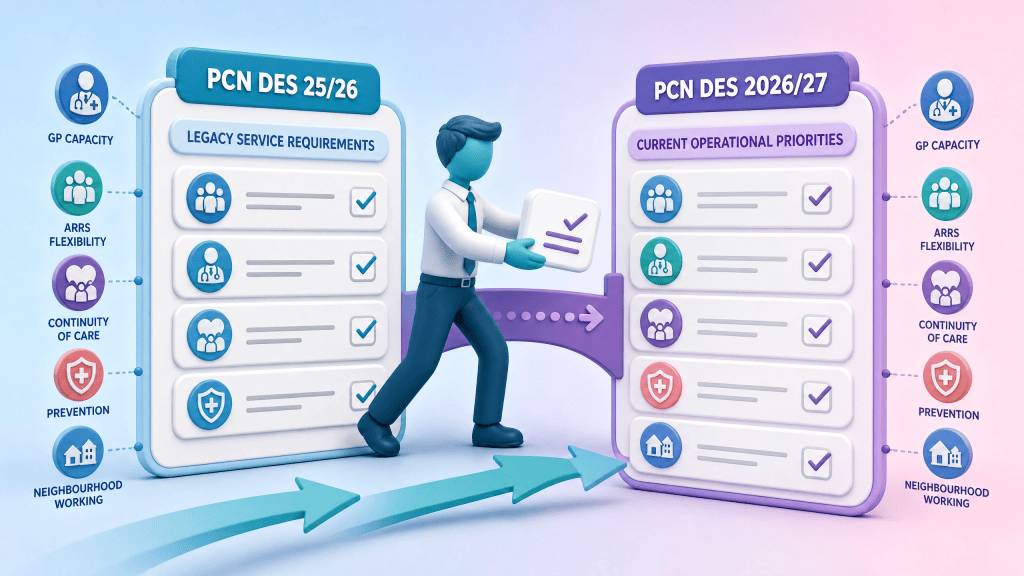
PCN DES 25/26 focused on access, workforce deployment, care home support, structured medication reviews, early cancer diagnosis and inequalities. PCN DES 2026/27 keeps many of these themes but places stronger emphasis on GP capacity, ARRS flexibility, continuity of care and practical delivery.
For PCNs comparing the PCN DES 25 26 position with the latest specification, the main task is to identify what has been retained, clarified or reconfigured. The DES contract 25 26 context still matters, but the page should now be read through the lens of the GP contract 2026/27 changes.
Historical searches such as PCN DES 24/25 remain useful for comparison. However, the current priority is understanding the new DES 26/27 requirements – also referred to as new DES 26 27 – and applying them safely across network services.
For a quick comparison, the most important shift is from understanding the contract to operationalising it safely across practices, teams and patient cohorts.
| Area | 25/26 position | 2026/27 position |
| ARRS | Defined role focus, with workforce planning central to delivery. | Greater flexibility where agreed with the commissioner, with stronger emphasis on capacity and safe deployment. |
| Capacity and access | PCN-level access improvement incentives remained prominent. | GP capacity is more directly linked to practice-level reimbursement and operational delivery. |
| Continuity of care | Encouraged through access and population health management. | Stronger practical emphasis on priority cohorts, risk stratification and consistent follow-up. |
| Neighbourhood working | Emerging as part of wider integrated care development. | More clearly aligned with local neighbourhood models and ICB priorities. |
| Delivery focus | Compliance, access and workforce mobilisation. | Measurable patient care, governance and sustainable implementation. |
What are the main PCN DES 2026/27 changes?
The main PCN DES 26 27 changes relate to GP capacity, ARRS flexibility, continuity of care, prevention and neighbourhood alignment. NHS England has confirmed that the Network Contract DES 26/27 documents are live for the current contract year.
| Area | What this means for PCNs |
| GP capacity | The former PCN-level Capacity and Access Payment is being repurposed into a practice-level GP reimbursement scheme. |
| ARRS flexibility | PCNs can use the Additional Roles Reimbursement Scheme (ARRS) more flexibly, including broader roles where agreed with the commissioner. |
| Continuity of care | PCNs are expected to identify priority cohorts and support more consistent care for higher-risk patients. |
| Cancer and prevention | Referral quality, screening uptake and safety-netting remain important delivery areas. |
| Care homes and vaccinations | PCNs should ensure eligible aligned care home residents are identified and offered seasonal and routine vaccinations. |
| Neighbourhood working | PCNs may need to work with ICBs and partners to align services with local neighbourhood arrangements. |

Need support with your PCN DES workforce plan?
Discuss your requirementsWhat does the PCN DES mean for patient care?
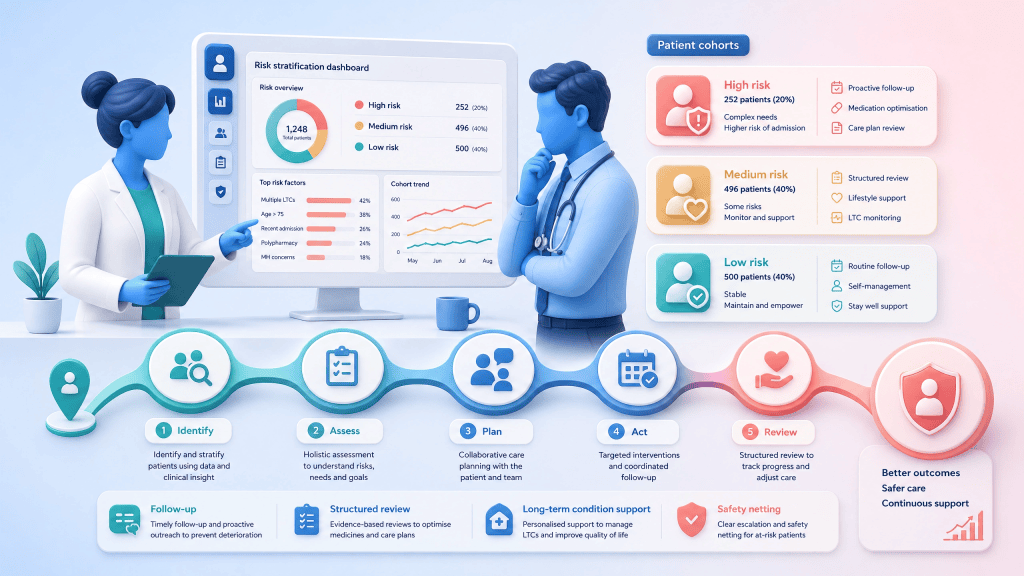
The framework should improve patient care when it is translated into clear pathways, safe workforce deployment and consistent follow-up. The strongest patient benefits are likely to come from better access, continuity and clinical risk management.
For higher-risk patients, continuity is particularly important. Risk stratification can help PCNs identify patients who need more proactive review, structured follow-up or coordinated input from a wider team.
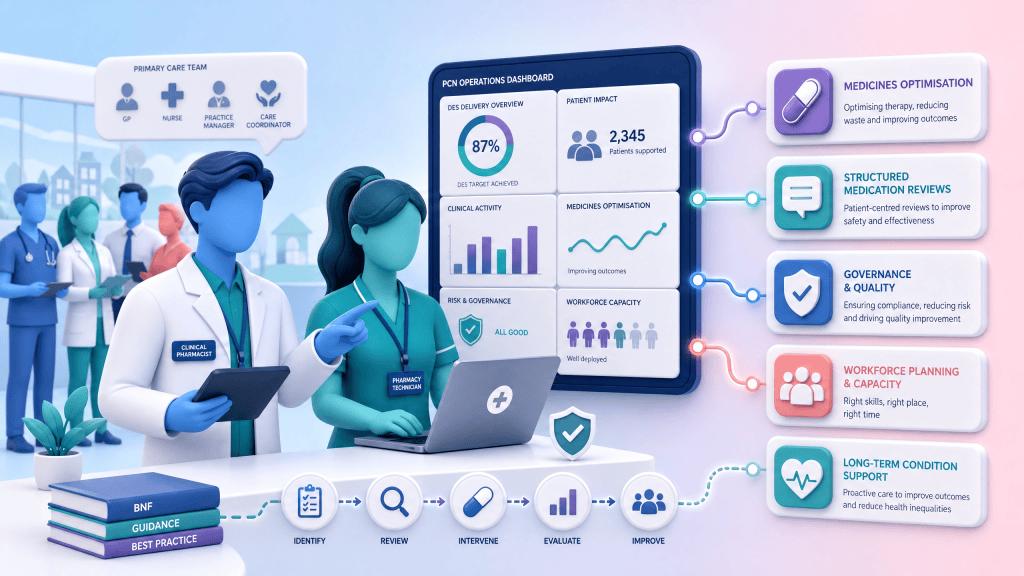
Clinical Pharmacy teams play a central role in delivering safe medicines optimisation, structured medication reviews and proactive long-term condition management. Through Medicines Optimisation Service delivery, PCNs can improve prescribing quality, reduce avoidable harm and support better management of long-term conditions.
Core Prescribing Solutions Insight: What We See in Primary Care
Working directly with PCNs and practice teams across England, we see where the PCN DES creates real pressure – and where it creates real opportunity.
The compliance gap is closing, but the delivery gap is widening. Most PCNs are meeting minimum requirements. The harder challenge is turning them into consistent patient care. Networks that are thriving have connected their workforce model to population data – not just ticked the boxes.
ARRS flexibility needs clinical governance to match. Broader role flexibility is welcome, but we regularly see ARRS roles deployed without clear supervision structures or integration into practice workflows. The flexibility only delivers value if governance keeps pace.
Continuity of care is where most PCNs are still finding their feet. In practice, many networks are still working out which patients belong in priority cohorts and who owns their follow-up. The ones making progress are using population health data proactively, not reactively.
Medicines optimisation is underused as a DES delivery lever. Clinical Pharmacy work is often treated as a separate workstream rather than a core part of the DES model. Integrating it into the delivery plan – not alongside it – produces better patient outcomes and stronger evidence for commissioners.
The networks that struggle most are the ones trying to do this alone. The ones making sustainable progress treat specialist support – Clinical Pharmacy, medicines optimisation, PCN management – as part of their delivery infrastructure, not an add-on.

How should PCNs respond to PCN DES 2026/27?
PCNs should respond to the 2026/27 specification by aligning workforce, data and delivery around patient need. A compliance-only approach is unlikely to be enough.
| Priority | Practical action |
| Workforce planning | Match GP, Clinical Pharmacist, Pharmacy Technician and wider MDT capacity to demand. |
| Continuity models | Identify high-risk cohorts and agree how they will receive consistent review and follow-up. |
| Data use | Use population health tools to prioritise patients and monitor delivery. |
| Service alignment | Link access, prevention, cancer pathways, care homes and long-term condition work into one operating model. |
| Governance | Keep clear supervision, audit and escalation processes in place. |
Core Prescribing Solutions can also support broader Primary Care Network Management and Support where networks need practical help turning requirements into delivery.
How do Clinical Pharmacists support PCN DES delivery?
Clinical Pharmacists support delivery by strengthening medicines safety, structured medication review activity and long-term condition care. They are most effective when their role is integrated into practice workflows rather than treated as a separate service.
A well-supported Clinical Pharmacist Support Service can help PCNs manage prescribing risk, improve review quality and release GP capacity. Pharmacy Technicians can also support recalls, data quality and medicines processes, with Clinical Pharmacists leading clinical decision-making.
Expert insight from Adeem Azhar, qualified Clinical Pharmacist and CEO
The PCNs that gain most from the DES are the ones that connect workforce planning with patient safety. Clinical Pharmacists and Pharmacy Technicians add most value when they are embedded into everyday pathways, not left working in isolation.
Adeem Azhar, MPharm, IPres
Co-Founder and Chief Executive Officer – Core Prescribing Solutions
Qualified Clinical Pharmacist
How does Core Prescribing Solutions support PCNs?
Core Prescribing Solutions supports PCNs with Clinical Pharmacy workforce, medicines optimisation and practical delivery support. The focus is on helping networks meet PCN DES requirements safely, without adding unnecessary pressure to practice teams.
Support can include Clinical Pharmacist provision, medicines optimisation, structured review processes, long-term condition support and governance-led delivery. This helps PCNs improve patient care while keeping services aligned with current NHS expectations.
Where can I read the official PCN DES guidance?
NHS England publishes the official Network Contract DES guidance and GP Contract 2026/27 changes each year. The guidance includes the full contractual requirements, service specifications and implementation information for Primary Care Networks. This article summarises the key operational changes and what they mean in practice.
FAQs
Looking for support with your PCN delivery plan?
If your PCN needs support with workforce planning, Clinical Pharmacist integration or medicines-focused delivery, Core Prescribing Solutions can help. We can work with your network to turn DES requirements into a practical delivery plan with clear priorities, responsibilities and workforce capacity.
Discuss your 2026/27 PCN DES delivery